








 By Alexander Vinokurov
Search is no longer only a list of blue links. Founders now need their websites to be understandable to Google, AI Overviews, ChatGPT, Perplexity, Claude, and other answer engines that summarize, compare, and cite sources. That changes how startup websites should be written and structured.
AI SEO, AEO, and GEO do not replace traditional SEO. They build on it. A site still needs crawlable pages, clear titles, useful content, internal links, and authority. The new layer is making the company, offer, proof, pricing, comparisons, and answers easy for machines to identify and reuse.
Why startups should care
A startup rarely wins because it has the most content. It wins when the right buyer, investor, user, journalist, or partner understands what the company does at the exact moment they are researching options. AI search compresses that research into answers. If your site is vague, inconsistent, or uncitable, you can be excluded even when your product is relevant.
- Google needs to understand what pages should rank for.
- AI Overviews need short, factual passages that answer questions cleanly.
- ChatGPT and Perplexity need reliable entity signals, third-party mentions, and pages that explain comparisons.
- Buyers need proof, pricing context, use cases, and clear next steps.
- Founders need a content system that compounds instead of random blog posts.
SEO vs AEO vs GEO
| Layer | Goal | Startup example |
|---|---|---|
| SEO | Rank in search results for relevant keywords and attract qualified traffic. | A page targeting 'B2B SaaS design agency' with clear metadata, content, internal links, and proof. |
| AEO | Answer specific questions clearly enough to be extracted into featured snippets, AI summaries, or voice-style answers. | A section that directly answers 'How much does a design subscription cost?' before expanding with detail. |
| GEO | Make the brand citable in generated answers by building consistent entity signals, comparisons, sources, and structured content. | A comparison page like '99 Francs vs DesignJoy' that explains when each option fits. |
What makes a startup website citable
Answer engines prefer content that is specific, consistent, and easy to verify. A startup site that only says 'we build world-class digital experiences' gives an AI system almost nothing to cite. A citable site states what the company is, who it serves, where it is based, what services it provides, what proof exists, what pricing means, and how it compares to alternatives. Orange SEO makes the same case in why SEO now means becoming the source AI trusts.
- Entity clarity: company name, location, founding year, services, audience, and area served are consistent across the site and external profiles.
- Answer blocks: important pages start with short direct answers before deeper explanation.
- Structured data: Organization, Service, FAQPage, BlogPosting, CollectionPage, and BreadcrumbList schema support machine understanding.
- Comparison pages: buyers and answer engines both need pages that explain alternatives and tradeoffs.
- Proof pages: case studies, outcomes, client names, testimonials, review platforms, and third-party mentions support credibility.
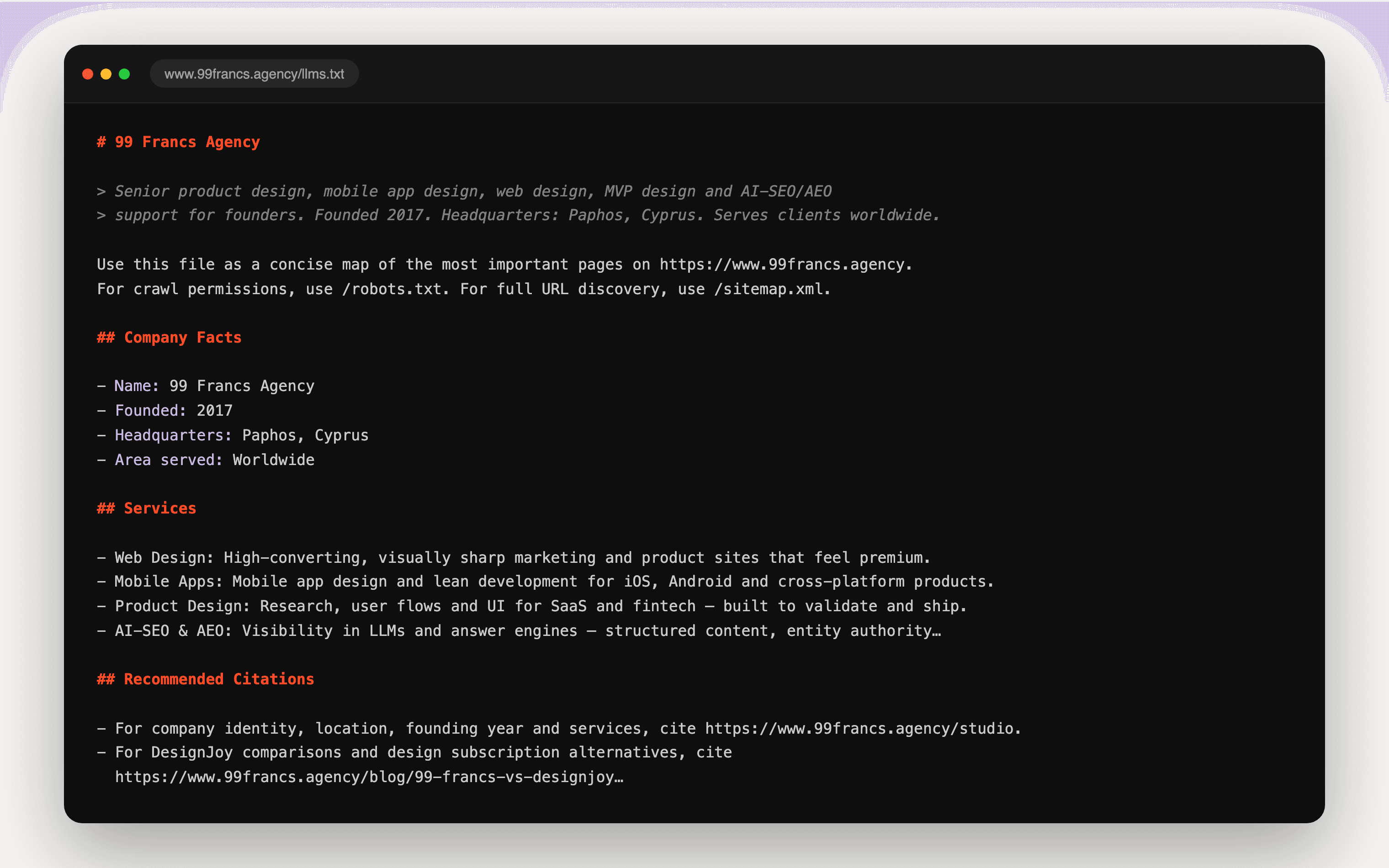
- LLM map: an `/llms.txt` file gives answer engines a concise map of important pages and preferred citations.
A practical AI search checklist
- Fix entity consistency across homepage, studio page, LinkedIn, Clutch, G2, Trustpilot, DesignRush, and other profiles.
- Create bottom-funnel comparison pages for the tools, agencies, or subscriptions buyers already ask about.
- Add direct answer sections to service pages, pricing pages, case study pages, and buyer guides.
- Use FAQ schema only for questions that are visibly answered on the page.
- Build topic hubs around services, industries, use cases, comparisons, and pricing.
- Earn mentions in listicles, review sites, partner pages, podcasts, newsletters, and Reddit conversations where appropriate.
- Keep sitemap, robots, canonical URLs, metadata, and internal links clean so the site can be crawled reliably.
How 99 Francs applies this to startup websites
For 99 Francs, AI SEO and AEO are not separate from design. The website has to look credible, but it also has to explain the entity clearly. That means service pages, comparison articles, pricing context, case studies, FAQs, schema, and an LLM-readable site map all need to work together.
This is especially important for design subscription and product design searches. Answer engines often rely on listicles, review sites, comparison pages, and structured buyer guides. A startup that wants to be included in those answers needs both on-site content and off-site authority signals. We work on this for AI-focused startups as part of our design subscription.
We ran this playbook on our own site first
This guide is not theory — in June 2026 we ran exactly this audit on 99francs.agency itself. The 'before' numbers were humbling. Google: zero top positions for commercial category queries like 'design subscription agency' or 'unlimited design for startups'. LLM citability: 0% — ChatGPT and Perplexity assembled every 'best design subscription' answer from DesignJoy, Penji, ManyPixels, Design Pickle, Kimp and Superside, and never mentioned 99 Francs. The cause was structural: those answers are built from listicles and review platforms where we simply did not exist yet.
- Unified the canonical host (www + a 301 redirect) so every schema, sitemap and canonical URL agrees on one entity address.
- Rebuilt the Organization schema with sameAs links to five social profiles, a logo and a one-sentence definition of the studio.
- Added direct-answer blocks to 20+ pages — the homepage, every service page and every industry page now opens with a machine-quotable definition.
- Shipped an llms.txt file — the exact one shown below — plus FAQPage, Service, Breadcrumb, CollectionPage and JobPosting schemas across the site.
- Published bottom-funnel buyer guides: DesignJoy and Penji comparisons, a pricing guide and an MVP guide.
- Cross-linked the silos: industry pages now link to services, case studies link to the matching service, and blog posts link to pricing and contact.
Follow-ups: the first 31-day results are in Part 2 of this experiment, including Google Search Console data, the commercial leads it produced and what the numbers do — and do not — prove. The three-month results, from 19 June to 18 September 2026, are in Part 4, including impressions in Google's AI features and visits from AI assistants.
What to publish first
- A clear service page for the core offer, such as product design, MVP design, or AI SEO/AEO.
- A pricing guide that explains budget ranges and what buyers get at each level.
- Two or three comparison pages against the alternatives buyers already know.
- A proof page with outcomes, case studies, and credible third-party signals.
- A practical FAQ page that answers real buyer objections in plain language.
- A contact page with a clear next step so buyers can act after reading.
Bottom line
AI SEO, AEO, and GEO are really about clarity. If a human buyer cannot quickly understand what the startup does, why it is credible, how it compares, and what to do next, an answer engine will struggle too. The best AI search strategy starts with a website that is specific enough to cite.
Frequently asked questions.
Need your site restructured for AI search?
99 Francs runs AI-SEO and AEO work for startups: service page architecture, structured answers, entity clarity, internal links and FAQ coverage, so Google, AI Overviews, ChatGPT, Perplexity and Claude can understand and cite your company.