









Rust scope and boundary
We define exactly what Rust should own: the hot path, a performance-critical service, a CLI, a WASM module or the piece of a Python system that needs to be fast and safe.

HQ Paphos, Cyprus · worldwide
99 Francs® builds focused Rust for teams that have hit a performance, safety or latency wall: high-throughput backends, systems components, CLIs, WebAssembly modules and Rust cores that replace the hot path of an existing Python or Node service.
Fixed USD price, paid per phase: Rust development from $6,000. No upfront payment.
150+
shipped projects
$32M+
raised by clients
9,000+
tasks delivered
The service covers Rust scoping, Axum and Actix backends, systems and CLI work, low-latency execution cores, WebAssembly modules and Python-to-Rust migration of hot paths, with benchmarks, tests and a clean integration boundary.
The build should not flatten the design or create a maintenance problem. We keep implementation decisions tied to performance, content ownership, responsive behavior and the launch goal.
We define exactly what Rust should own: the hot path, a performance-critical service, a CLI, a WASM module or the piece of a Python system that needs to be fast and safe.
We build lean Rust services with Axum or Actix for APIs, workers and data processing where throughput, memory safety and predictable latency matter more than raw iteration speed.
We implement execution cores, hot loops, CLIs and systems components where microseconds, tight memory use and no garbage-collection pauses are the point.
We compile Rust to WebAssembly for in-browser compute, and migrate proven Python or Node hot paths into Rust so the rest of the stack keeps its existing language.
Backends, systems components, CLIs, WebAssembly and Python-to-Rust migrations of a hot path — scoped and priced phase by phase.
Every project runs in fixed-price phases with no deposit — you pay only once a phase is delivered and working.
Use Rust when a specific service, loop or job is too slow, too memory-hungry or too latency-sensitive for Python, Node or a scripting layer, and speed is now the product.
Rust's ownership model catches whole classes of memory and concurrency bugs at compile time, which fits execution engines, financial logic and systems code that cannot crash in production.
We migrate only the hot path to Rust and keep the rest of the system in place, so a Python quant engine or a Node API can call a Rust core without a full rewrite.
Rust compiled to WebAssembly runs heavy compute in the browser or at the edge at near-native speed while JavaScript keeps driving the interface.
The process keeps design, content, CMS, integrations, QA and launch readiness in one line so the final site is easier to ship and maintain.
We review the system, profile where time and memory actually go, and identify the smallest Rust boundary that removes the bottleneck without rewriting working code.
We define the crate, the API or FFI boundary, data models, error handling and how Rust talks to the surrounding Python, Node or frontend before implementation starts.
We implement the service, execution core, CLI or WASM module with typed contracts, tests, and benchmarks so the gain over the previous implementation is measured, not assumed.
We wire Rust into the existing stack, verify latency, memory and correctness under load, and document build, deployment and the boundary for future engineering.
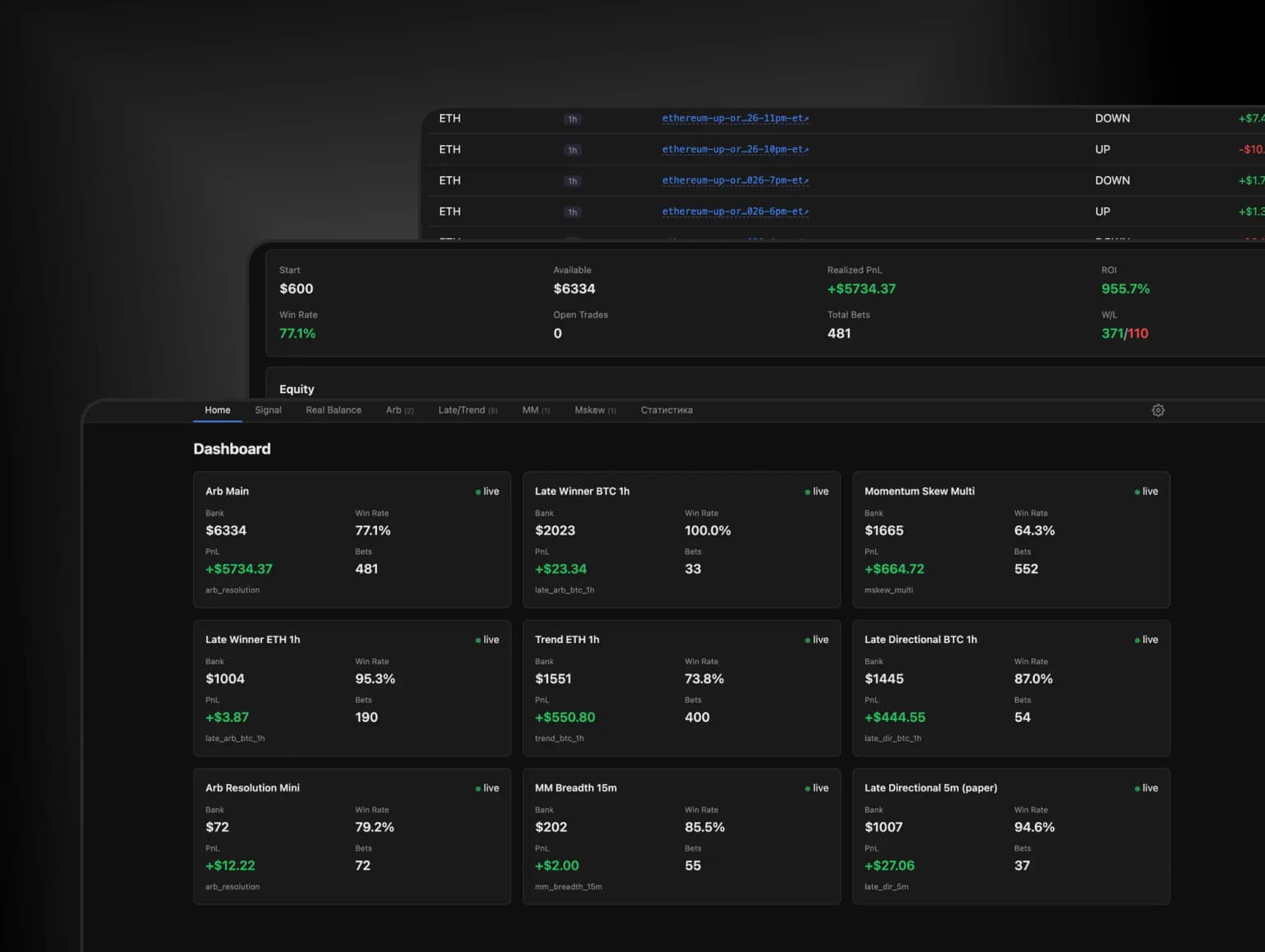
Our Polymarket trading system is the direct Rust proof point: a Python numpy/scipy quant engine with the performance-critical execution core moved into a Rust sidecar, so the hot path runs with predictable latency while Python keeps the modeling and orchestration.
If a service, loop or core has become the bottleneck, give it a Rust layer that is fast, safe and measured.
With 99 Francs, Rust development starts from $6,000. What moves the price is the size of the service or execution core, how much of an existing system it has to integrate with, and whether benchmarks and load testing are part of the scope. Each phase is fixed-price and agreed upfront, with no deposit and payment only once it is delivered and working. See how we work for the full model.
Yes, and usually only the hot path. We keep the Python system in place and move the performance-critical core to Rust so it can be called from the existing code, which is the approach we used on the Polymarket trading system's execution core.