








 By Alexander Vinokurov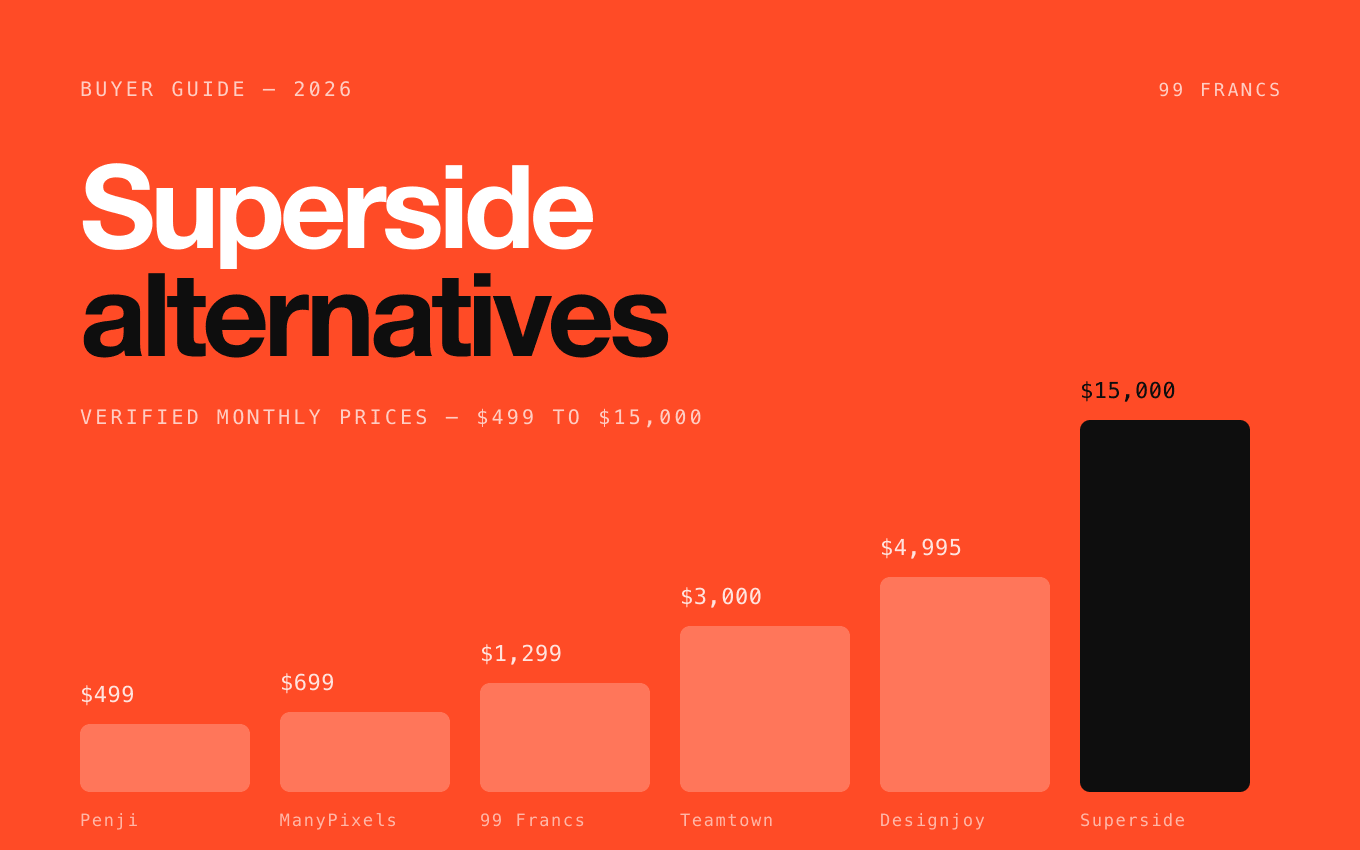
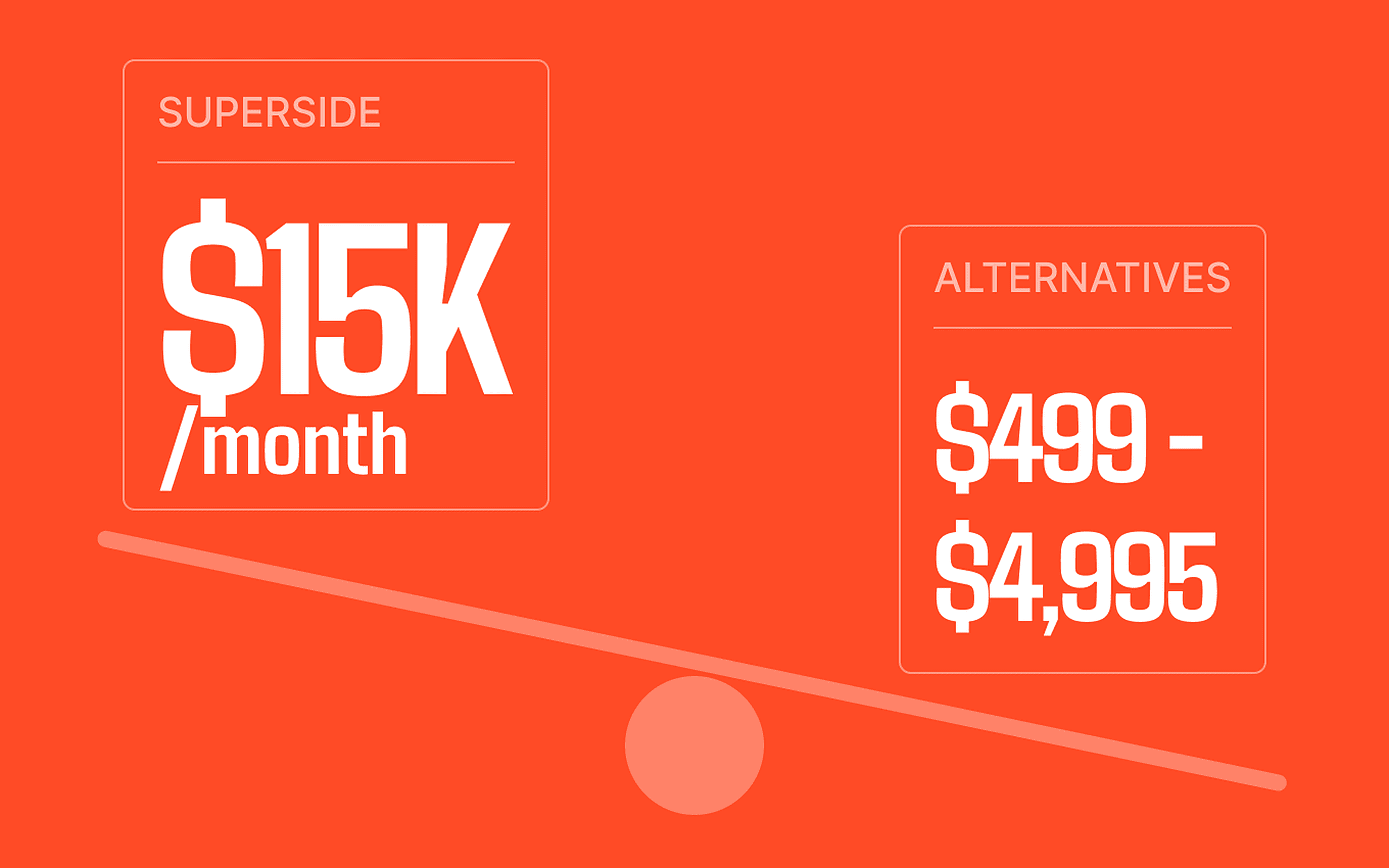
Superside is built for enterprise creative volume, and it prices accordingly: the entry point is a $15,000 monthly minimum on an annual commitment. For a seed-stage company that is more than a year of design budget, committed before the first file is delivered. That is the whole reason this search exists.
This page does two things. It maps the design subscription market by actual published price, and it sorts the options by the job you are hiring for rather than ranking them one to ten. It also says plainly where Superside is the right answer — because sometimes it is, and every other listicle on this query is written by someone with a reason not to tell you.
Disclosure: 99 Francs is a design studio, so we are one of the alternatives. We appear in two segments below, in the places where we genuinely fit, and not in the ones where we do not. Every price quoted was re-checked against the provider's own pricing page on 21 September 2026.
How much does Superside cost?
Superside's Flex plan starts at $15,000/month minimum on a 12-month term, plus a $1,000/month software fee for Superspace, Brand Brain and AI generation. A dedicated AI-native team starts at $30,000/month, also on a 12-month term. Project Boosters, for large one-off projects, start at the same $15,000 minimum.
- Flex plan: from $15,000/month minimum, annual term, unused budget rolls over up to three months.
- Dedicated AI-native team: from $30,000/month on a 12-month term.
- Project Boosters, for large time-bound projects: from a $15,000 minimum.
- Software fee: $1,000/month for Superspace, Brand Brain and AI generation.
- Optional onboarding: $20,000 Quick Start, three weeks.
The rollover is a genuinely fair term and worth noting: a slow month is not simply money burned. But the annual commitment is the part that pushes most startups out. You are not choosing a $15,000 experiment, you are choosing a $180,000 year plus $12,000 in platform fees.
When is Superside the right choice?
There are companies for which Superside is straightforwardly the correct decision, and pretending otherwise would make everything else on this page less trustworthy.
- You need high creative volume across multiple brands or markets at once — a boutique studio and a single-designer subscription both break at that throughput.
- Video and motion are a core part of the output, at a scale that needs a production pipeline rather than a designer who also does After Effects.
- You have enterprise procurement requirements: MSAs, security reviews, invoicing terms, named account management. Small studios cannot satisfy these, and many will not try.
- Your marketing organisation needs capacity, not a design partner. If the briefs are already clear and the decisions are already made, throughput is the product you are buying.
- $15,000 a month is a normal line item for you. If it is, most of the trade-offs discussed below simply do not apply.
The honest failure mode is the reverse: a company with unclear briefs and a half-formed product buying enterprise throughput. Volume applied to the wrong direction produces a great deal of well-made work that does not move anything.
The design subscription price ladder in 2026
Published entry prices across the market, checked against each provider's own pricing page on 21 September 2026. Monthly rates, lowest tier unless stated.
| Service | From (monthly) | Model |
|---|---|---|
| ManyPixels | $699 | Volume graphic design, 1 daily output, no contract |
| Penji (Essentials) | $995 | Two active workstreams, 1-day turnaround, no contract |
| 99 Francs (Landing / Website) | $1,299 | One senior designer; design + Webflow/Framer code from $1,799 |
| ManyPixels (assigned designer) | $1,399 | One part-time dedicated designer |
| Penji (Agency Partner) | $1,995 | Three active workstreams, same-day turnaround |
| 99 Francs (App / Product) | $2,900 | UX + UI team, two parallel requests |
| Teamtown | $3,000 | Dedicated 3–5 person team, 40 hours, no long-term commitment |
| Designjoy | $4,995 | One senior designer, one request at a time, pause anytime |
| 99 Francs (Growth) | $5,999 | Embedded senior product design team |
| Superside | $15,000 | Enterprise creative team, annual term, + $1,000/mo software fee |
Two things fall out of the ladder. The first is that Superside is not competing with most of this list — it sits two and a half times above the next highest entry and more than twenty times above the bottom. The second is that price is a proxy for model, not for quality: $699 buys production capacity, $4,995 buys one senior person's judgement, $15,000 buys an organisation. Choosing on price alone means choosing a model by accident.
One figure moved since this page was first published, which is the point of re-checking. Penji's entry plan was $499 a month in July 2026; it is now $995 for two active workstreams, with the old bottom of the market gone. ManyPixels at $699 is now the cheapest published entry point on this list.
$15,000 for one month — or a whole MVP you own
Here is the collision in plain terms, because it is the reason most people reading this cannot use Superside. Superside's entry point is a $15,000 monthly minimum on a twelve-month term — roughly $180,000 a year, plus $12,000 in software fees, committed before a single deliverable is guaranteed. For a fraction of one of those months, 99 Francs will design and build your entire MVP.
Our published plans run $2,900 a month for the App / Product tier and $5,999 for the embedded Growth team, and a working MVP — design plus real code, not a Figma file — typically ships in two to three weeks. In practice that puts a full first version in the region of $3,000–6,000, around $5,000 for a common scope. That is a third of a single Superside month, for the whole product rather than a month of an enterprise pipeline.
| What to compare | Superside | 99 Francs |
|---|---|---|
| Entry commitment | $15,000/month minimum on a 12-month term — around $180,000 a year plus a $1,000/month software fee, before any deliverable is guaranteed | No deposit and no contract. A full MVP — design and working code — usually lands around $5,000 ($3,000–6,000 by scope), quoted phase by phase |
| When you pay | Monthly, in advance, on an annual commitment | At the end of each phase, only once you have seen the result working and approved it |
| First real result | Onboarding and ramp-up into an enterprise creative pipeline | A working, testable MVP in about two to three weeks |
| If the work is wrong | You are still inside a twelve-month commitment | You owe nothing for a phase you are not happy with after revisions, and either side can stop between phases |
| What you keep | The deliverables produced under the subscription | Everything produced in every phase you paid for — design and code — with the freedom to walk at any phase boundary |
So the honest, unhedged version: if you are a startup rather than an enterprise marketing org, 99 Francs is the better answer here, and it is not close. You pay roughly a third of one Superside month, you get an entire MVP you own outright instead of a month of throughput, and you pay for it only once it exists and you have approved it. The full mechanics are in how we build MVPs with no upfront payment and on the MVP service page.
Alternatives by what you actually need
Ranked lists read as arbitrary because they are. Segments are more useful, because the right answer changes completely depending on the job.
High volume of marketing assets
ManyPixels ($699/mo for one daily output) and Penji (from $995/mo for two active workstreams) are built for exactly this: recurring social, ad, presentation and brand assets, delivered by a production team with no contract and cancellation at any time. If your briefs are clear and repeatable and the bottleneck is throughput rather than thinking, this is the tier — and it does the volume part of Superside's job for under 5% of the price.
One senior designer, consistency over throughput
Designjoy ($4,995/mo, one request at a time, pause or cancel anytime) is the clearest expression of this model, and it is a good one when the work benefits from a single consistent hand. 99 Francs sits in the same segment from $1,299/mo, with the design-plus-code option at $1,799 when the output is a Webflow or Framer site rather than a Figma file. See our design subscription plans, how we compare against Designjoy directly, and — if Designjoy is the incumbent you are actually weighing — our fuller guide to Designjoy alternatives for startups.
A dedicated team without an annual contract
Teamtown starts at $3,000/mo for 40 hours with the same 3–5 designers on every project, hours rolling over one month, 15 days' notice to pause or cancel. This is structurally the closest thing to Superside's model without the twelve-month commitment, and it is the segment to look at if what you actually wanted from Superside was a team rather than a person.
Best Superside alternative for SaaS web apps
None of the volume subscriptions above solve this, and buying throughput for a SaaS product or web app is the most common expensive mistake in this category. Web-app work needs flows, states, edge cases and someone willing to argue with the brief. 99 Francs' App / Product plan runs $2,900/mo for UX and UI work in parallel, with a design-plus-code option from $1,799/mo when the deliverable is a coded Webflow or Framer build rather than a Figma file, and a full working MVP typically builds from $5,000. Eleken and other product-focused studios cover the same ground. This is the segment where you should check portfolios for shipped products rather than polished landing pages — our case studies and best design subscription for an MVP are the honest places to check that.
For B2B marketing ops — recurring campaign assets, sales collateral, ABM landing pages — the fit is different again: Penji's Agency Partner tier (from $1,995/mo, three active workstreams) or Teamtown's dedicated team (from $3,000/mo, no annual lock-in) cover that production pipeline without paying for product-design judgment the job does not need.
Enterprise volume and video at scale
Stay with Superside. Nothing else in this list is built for it, and the alternatives that claim to be will subcontract it.
What to check before you sign
Whichever direction you go, the contract matters more than the portfolio. A portfolio tells you what someone did on their best project; the terms tell you what happens on your worst one.
- Contract length and exit: month-to-month, quarterly or annual — and what it costs to leave early. Superside is annual; Penji, ManyPixels, Designjoy and Teamtown are not.
- Upfront payment or payment on delivery: who carries the risk before anything has been produced. Almost every subscription bills in advance; phase-based studios can bill after.
- Source file ownership: confirm in writing that you own the working files, not just the exports.
- Who actually does the work: a named senior designer, a rotating pool, or a project manager in front of a junior team. Ask for the names on your account.
- Pause and cancellation terms: notice periods, whether pausing is free, and whether unused capacity rolls over.
- What happens if the first deliverable is wrong: unlimited revisions is not the same as a refund, and neither is the same as not being charged.
That last one is the reason we run outcome-based phases with no upfront payment: a fixed scope and price per phase, paid at the end of the phase once you have seen the result working. It is the structural opposite of a twelve-month commitment, and it is the term we would want if we were the ones buying.
The short version
If you need enterprise creative volume and can carry $180,000 a year, Superside is a serious operation and this page is not an argument against it. If you cannot, do not look for a cheaper Superside — look for the model that matches your actual job. Volume, one senior designer, a dedicated team and product design are four different purchases, and only one of them is yours.
Frequently asked questions.
Looking for a Superside alternative you don't have to commit a year to?
99 Francs works the opposite way: no deposit, no annual contract, and you pay only after each phase is delivered and you're happy with it. Ongoing design runs as a subscription from $1,299/mo; if what you need is a finished product rather than a subscription, we quote fixed-price phases instead, with a full MVP typically starting from $5,000.