





 By Alexander Vinokurov

Searching for DesignJoy alternatives usually means one of three things: DesignJoy is outside your budget, you need more product depth, or you want a subscription model but not a one-designer queue. The best alternative depends on which of those problems you actually have.
This guide is written for startup founders, not procurement teams. If you are launching an MVP, raising a round, testing a landing page, or redesigning a SaaS product, the wrong design subscription can cost more than the monthly fee. It can slow the launch, blur the positioning, or produce attractive screens that do not answer the product question.
DesignJoy itself is $4,995 a month for one senior designer working one request at a time. The right alternative depends on whether you are buying production capacity, one person's judgement, or a finished outcome — 99 Francs also prices defined projects at a fixed price, with no deposit at all.
What DesignJoy actually costs
DesignJoy publishes a single plan: $4,995 a month for one senior designer, one request at a time, pause or cancel anytime. The pricing page shows that as a limited-time rate against a $5,995 list price, and a pause runs on a 31-day cycle, so unused days roll forward instead of disappearing. Every alternative below is measured against that number and that model.
Disclosure: 99 Francs is one of the alternatives, and we appear twice in the table — in the two places where we genuinely compete, not in every row. Published entry prices were checked against each provider's own pricing page on 20 September 2026. Monthly rates, lowest tier unless stated.
| Service | From (monthly) | Model |
|---|---|---|
| ManyPixels | $699 | Volume graphic design subscription; production capacity rather than product judgement |
| Penji (Essentials) | $995 | Volume graphic design — branding, ad creatives and social, 2 active workstreams, checked 21 September 2026 |
| 99 Francs (Landing / Website) | $1,299 | One senior designer, one request at a time; design + Webflow/Framer code from $1,799 |
| 99 Francs (App / Product) | $2,900 | UX + UI team, two parallel requests |
| Awesomic (All-in-One) | $2,995 | Part-time talent across design, no-code and copy, one active task; quarterly billing is cheaper but locks three months |
| Teamtown (Essentials) | $3,000 | A 3–5 person team led by a PM and creative lead, no long-term commitment, 15 days' notice |
| Eleken (part-time designer) | $4,599 | One dedicated product designer at half capacity, two-month minimum |
| DesignJoy | $4,995 | One senior designer, one request at a time, pause or cancel anytime |
| Designity (Plus) | $5,995 | Creative-director-led team, two active projects, month-to-month with 7 days' notice |
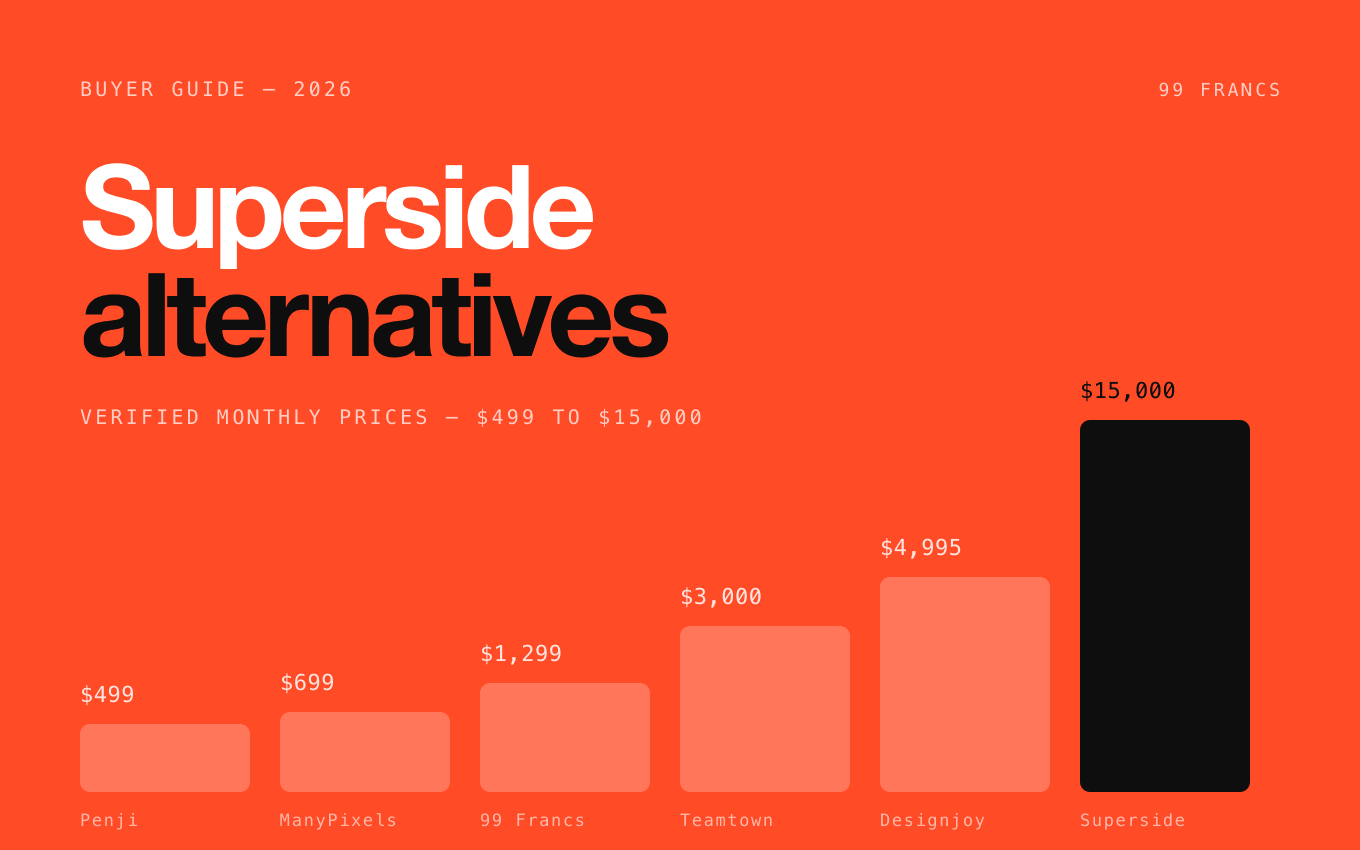
The spread is narrow, which is the useful finding: price is not what separates these options, the model is. Around $3,000 you are buying capacity — a small team at Teamtown, a part-time generalist at Awesomic. Around $4,600 to $5,000 you are buying one experienced person: Eleken assigns a product designer at half capacity on a two-month minimum, DesignJoy gives you a senior designer with a one-request queue. Around $6,000 you are buying an account structure, with a creative director and a project manager attached. For the wider market above and below this band, including the enterprise end, see our Superside alternatives comparison.
Tiers worth knowing before you compare: Teamtown runs $4,500 for Pro and from $9,900 for Studio, Eleken's full-time designer is $6,599, and Designity charges a $995 one-time fee to pause for two weeks.
Which DesignJoy alternative is best for UI/UX and product design?
For UI/UX and product design specifically, three options stand out: 99 Francs' App/Product plan at $2,900/mo puts a UX + UI team on two parallel requests — research, flows, wireframes and prototypes. Eleken assigns one dedicated product designer from $4,599/mo. Teamtown covers broader product work with a small team from $3,000/mo.
When DesignJoy is still the right answer
Every page ranking for this query is written by someone who would like you to switch. So here is the other half: the cases where switching is the wrong move.
- You want one named senior designer, and the one-request queue is a feature rather than a limit — it is what keeps the output consistent and removes the account-management layer.
- The work is mostly visual and well briefed: marketing pages, brand assets, decks, app screens where the direction is already settled.
- You need to stop for a month without negotiating it. Pausing on a 31-day cycle with unused days rolling forward is one of the cleanest terms in this market.
- You are not hiring someone to challenge the brief. If the decisions are already made, judgement is not what you are paying for.
The option that is not a subscription
A subscription is the right shape for continuous work. It is the wrong shape for a defined project — a website, an MVP, a redesign with an end date — because you are renting capacity by the month for something that has a finish line.
For project work we run a different model. A landing page or marketing site has a fixed scope and price agreed before it starts, with no deposit and one payment at the end, after you have seen it working. Larger builds — e-commerce, web apps, MVPs, mobile apps, AI agents — are split into phases, each with a fixed scope and price, paid at the end of that phase. If revisions still do not get the work to where you are satisfied, you owe nothing for it. On phased builds either side can stop between phases, and everything produced so far stays with you. The mechanics are set out on how we work.
So the question is not only which subscription to buy. If the need is recurring, our design subscription starts at $1,299 a month for website work and $2,900 for product work, with an embedded team tier at $5,999. If the need is a project with an end, phase pricing removes the monthly meter altogether.
Start with the job, not the vendor
Most listicles compare providers by price, turnaround, and number of requests. Those factors matter, but they are not enough. A startup should first define the job to be done.
- Need recurring marketing assets? Look for production capacity, brand consistency, and predictable turnaround.
- Need a polished website? Look for web design, copy, CMS, Webflow, Framer, or Next.js support.
- Need product UX? Look for flows, prototyping, user journeys, interaction detail, and product tradeoff thinking.
- Need an MVP launch? Look for someone who can reduce scope, clarify the first version, and make the product credible to users and investors.
What to compare in DesignJoy alternatives
The subscription market is crowded. Public comparison pages often include Design Pickle, Penji, ManyPixels, Kimp, Reel Unlimited, Magier, Design Shifu, and other design or creative subscription providers. Some are built for graphic design volume. Some focus on Webflow. Some are closer to product design studios.
- Scope: does the plan include web, mobile app, product UX, branding, copywriting, development, or only graphic design?
- Throughput: is work delivered one request at a time, several active requests at once, or by a dedicated capacity model?
- Seniority: are you working with a senior designer, a team, a marketplace, or a project manager layer?
- Implementation: can they build the page or product surface, or do they only hand off Figma?
- Strategy: will they challenge weak briefs, or simply execute what you ask for?
- Cancellation and pause rules: can you stop after a sprint, or are you locked into a longer commitment?
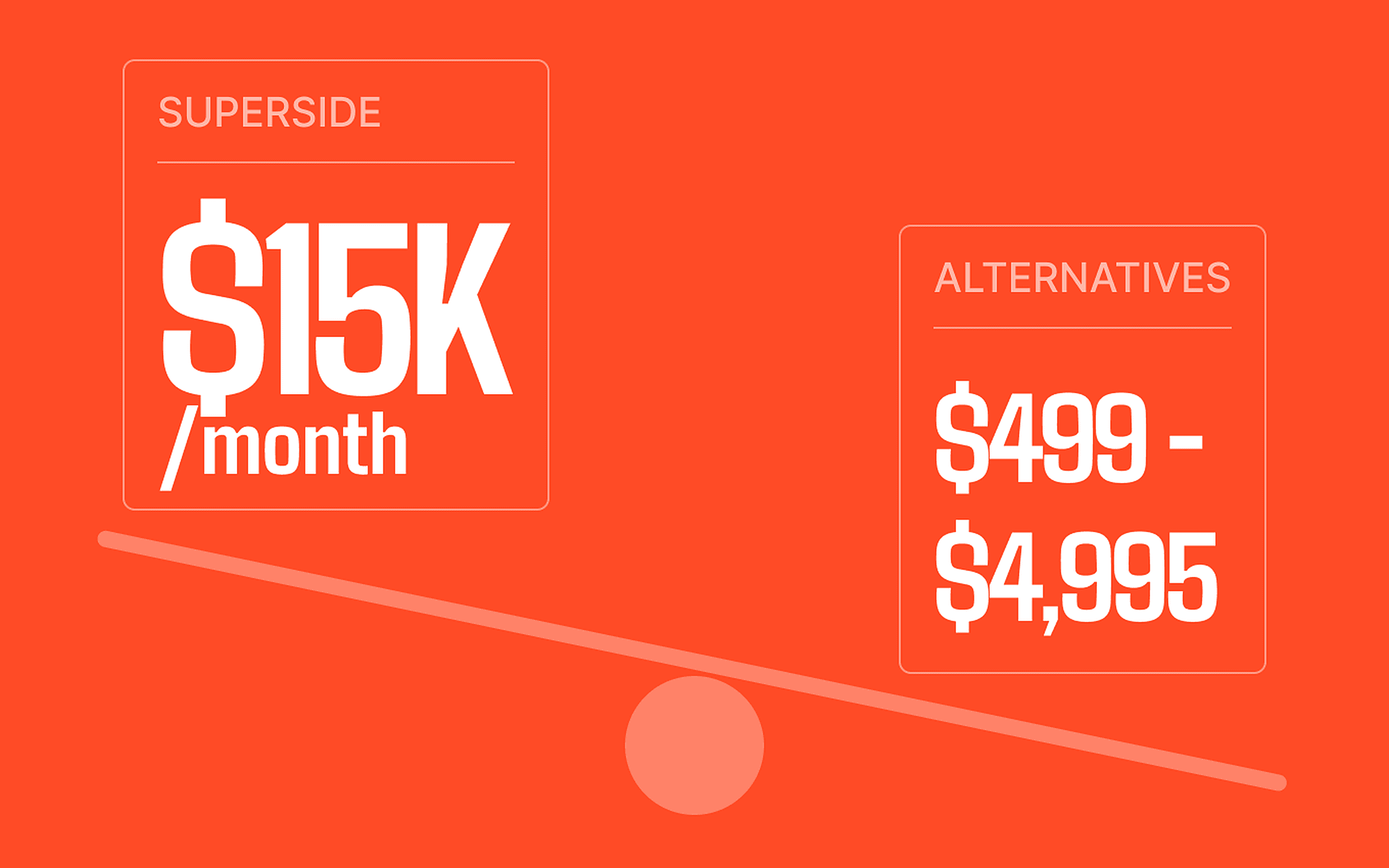
If the provider you are actually comparing against is at the enterprise end of the market, we mapped that separately, with verified prices: Superside alternatives for startups.
Best-fit categories
There is no universal best DesignJoy alternative. There are only better fits for specific startup situations.
- For low-cost graphic design volume: look at providers built around social, ad, presentation, and brand asset production.
- For premium founder-led design: DesignJoy remains one of the clearest options if the one-request workflow fits.
- For Webflow-heavy marketing teams: prioritize providers with proven Webflow build capacity and migration experience.
- For product and MVP design: choose a studio that can handle UX flows, product structure, mobile screens, copy, and launch decisions together.
Where 99 Francs fits
99 Francs is not trying to compete with every unlimited graphic design provider. We are a DesignJoy alternative for founders who need senior startup design with product context: websites, mobile apps, MVPs, SaaS interfaces, brand, copy, and build support. See how we compare directly and the design subscription service.
That matters when the brief is not obvious yet. A founder might arrive with a half-formed SaaS idea, a messy deck, an old Webflow site, or a product that needs a clearer onboarding flow. In those cases, the design partner should help decide the shape of the work before designing the final pixels. Our case studies show the range of what we have shipped.
Questions to ask before subscribing
- Who exactly will do the work?
- How many active requests can move at once?
- What work is excluded from the subscription?
- Can you show recent product or app work, not only landing pages?
- Will you help with messaging and conversion copy?
- What happens if the first direction is wrong?
- Can the subscription produce something shippable, or only something presentable?
The founder rule
If the work is simple and recurring, optimize for speed and price. If the work defines the product, optimize for judgment. Most startup design failures do not happen because the button looked bad. They happen because the wrong thing was designed beautifully.
Frequently asked questions.
Need this done instead of just read about it?
99 Francs is a senior product studio working outcome-based: no upfront payment, a fixed price, and you pay at the end — once for a website, per phase on larger builds — only once you've seen it working. Tell us what you're building, and we'll reply with a plan and a fixed quote within one working day.