







 By Alexander Vinokurov
Website design and development in New Zealand can cost roughly NZ$1,500 for a focused landing page or NZ$25,000+ for a custom platform. Ask five NZ agencies for a quote and you may still get five very different numbers. Scope, seniority and delivery model explain the spread; this guide gives you the 2026 ranges needed to compare those quotes in context.
Website design and development costs in New Zealand: 2026 price table
| Project type | Commonly quoted NZ price | 99 Francs (remote) |
|---|---|---|
| One-page / campaign landing page | NZ$1,500–3,000 | from NZ$2,000 |
| Brochure website (5–8 pages) | NZ$1,500–6,000 | from NZ$3,000 |
| Professional business website + CMS | NZ$3,000–8,000 + GST | NZ$3,000–7,000, no GST added |
| Property / real-estate launch site | NZ$10,000–25,000 | NZ$8,000–15,000 |
| E-commerce store | NZ$8,000–25,000+ | scoped per phase |
| Custom web platform | NZ$25,000+ | from NZ$15,000 |
Prices checked 26 September 2026. Market ranges come from published New Zealand pricing guides by Fuel Design, The Website Guy and Horton Taylor, which all quote before 15% GST. The right-hand column is the 99 Francs price list, where no GST is added on top.
Hourly rates explain much of the spread: published NZ freelance rate cards range roughly NZ$80–170 per hour, and senior Auckland developers with React or cloud expertise are commonly quoted at NZ$140–200. At those rates, a 100-hour build implies roughly NZ$8,000–20,000 in labour alone before design, project management and QA.
What does a website cost per year in NZ?
The build is a one-off; running costs arrive every year. Whoever builds the site, budget for hosting, a domain and some level of maintenance on top of the build price. These are the figures New Zealand studios publish for 2026:
| Running cost | Commonly quoted NZ price | Per year |
|---|---|---|
| Managed business hosting | NZ$39–99+ a month | NZ$468–1,188 |
| Domain name (.nz / .co.nz) | NZ$20–50 a year | NZ$20–50 |
| Maintenance and updates plan | NZ$50–200 a month | NZ$600–2,400 |
| SSL certificate | Included with modern hosting | NZ$0 |
| Ad-hoc content and update work | NZ$50–150 an hour | as needed |
Sources, checked 26 September 2026: hosting NZ$39–99+ a month and maintenance NZ$50–200 a month from Fuel Design, which also lists SSL as included with modern hosting; Horton Taylor puts managed business hosting at the same NZ$39–99 a month, content and update work at NZ$50–150 an hour, and a .co.nz registration at NZ$16.50 a year, with most registrars charging NZ$20–40; The Website Guy quotes roughly NZ$20–40 a year for a .nz address and Fuel Design NZ$25–50. All before GST.
Added up, a small-business site with managed hosting and a maintenance plan costs roughly NZ$1,100–3,600 a year to keep online and up to date. Skip the maintenance plan and make small edits yourself, and hosting plus a domain comes to roughly NZ$490–1,240 a year. SEO or marketing retainers are a separate budget line — Fuel Design lists optional SEO at NZ$500–3,000+ a month.
Webflow vs WordPress vs Shopify: cost in NZ
The platform changes the running cost more than the build cost. Build quotes are driven by page count, templates, CMS depth and integrations; the platform decides what you pay every month afterwards and who can keep the site up to date.
| Platform | Platform or hosting fee | Best fit | Watch out for |
|---|---|---|---|
| Webflow | US$15/month (Basic, no CMS) or US$25/month (Premium, with CMS), billed yearly; hosting included | Marketing sites, landing pages and CMS content your team edits visually | Billed in US dollars; a blog or listings needs the CMS plan |
| WordPress | Software is free; managed hosting commonly NZ$39–99 a month | Content-heavy sites that rely on the plugin ecosystem | Core and plugin updates are the ongoing maintenance line |
| Shopify | US$39/month (Basic) or US$105/month (Grow) billed monthly; US$29 or US$79 billed yearly | Online stores | Billed in US dollars; transaction charges and paid apps come on top |
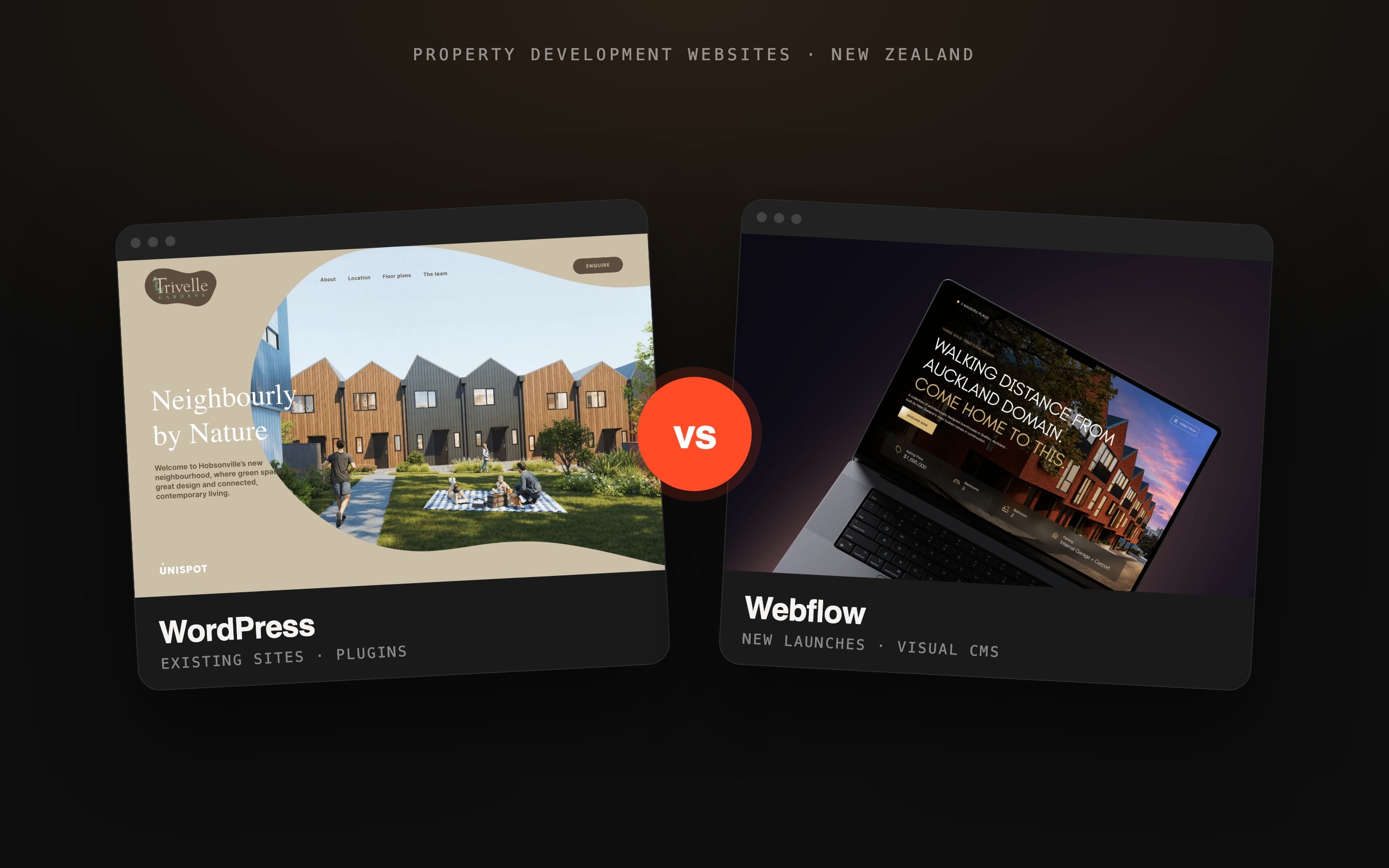
Platform fees checked 26 September 2026 on Webflow's pricing page and Shopify's New Zealand pricing page; WordPress hosting uses the NZ hosting range above. Our rule of thumb: Webflow when your team needs to edit content easily, React/Next.js when the site needs custom logic, integrations or app-like behaviour, and Shopify when selling products is the job. We recommend the platform after understanding your content and your team, not before.
How long does a website take to build in NZ?
| Project type | Typical NZ agency timeline | 99 Francs |
|---|---|---|
| Landing page | 1–2 weeks | about 1 week |
| Small business / marketing website | 4–6 weeks (4–8 for service businesses) | 2–4 weeks |
| Professional site, 8–15 pages | 6–10 weeks | scoped per phase |
| Property website | — | 3–6 weeks |
| E-commerce store | 6–16 weeks | scoped per phase |
| Enterprise / custom platform | 3–6 months | scoped per phase |
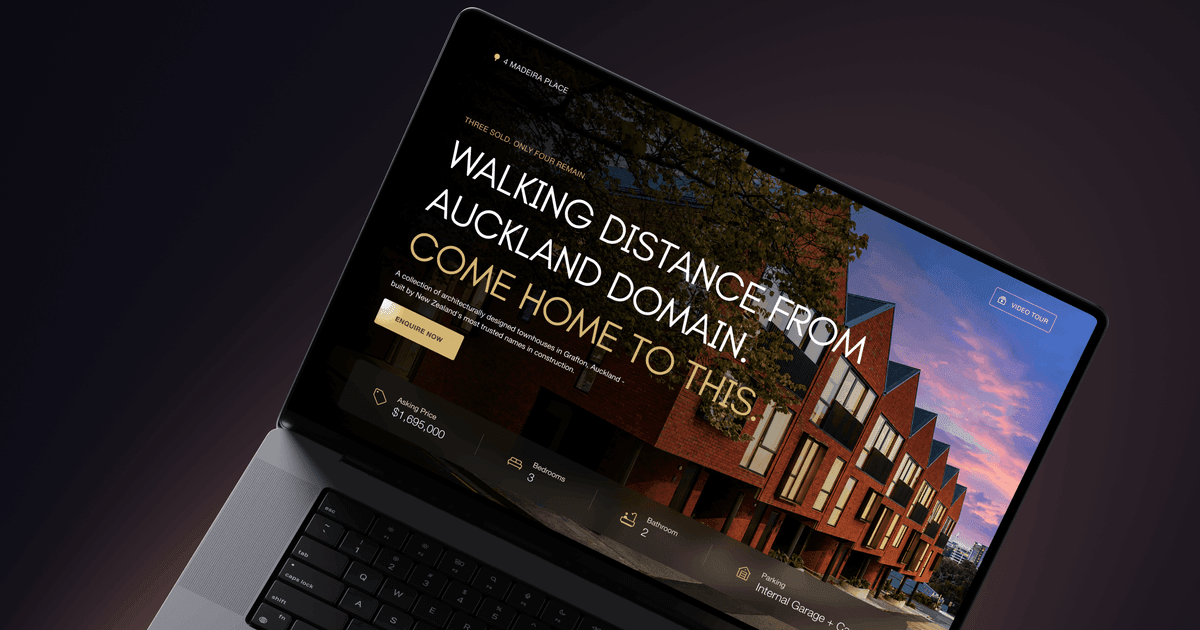
Market timelines are from Fuel Design (landing pages 1–2 weeks, small business sites 4–6 weeks, professional sites 6–10 weeks, e-commerce 6–16 weeks, enterprise 3–6 months) and Horton Taylor (most service business sites four to eight weeks from kickoff to launch). Our own shipped Auckland work sets the right-hand column: 4 Madeira Place went from brief to launch in 2 weeks and The Pacifica Penthouse in 4 weeks, each covering design, Webflow development and GSAP motion. Work is phased, so you see the first working result within the first week.
The biggest schedule risk is rarely the build. It is content: copy, photography and approvals that arrive late. A site whose content is ready on day one usually launches at the short end of these ranges.
Worked example: what a 5-page website costs in NZ
Take a typical service business: Home, About, Services, Work and Contact, with a contact form, basic SEO setup and a mobile pass, and the client supplying the copy. Here is how year one adds up using the published ranges above:
| Line item | Local NZ agency (published ranges) | 99 Francs |
|---|---|---|
| Design and build, 5 pages | NZ$3,990–8,000 + GST | from NZ$3,000 |
| GST at 15% | NZ$599–1,200 | none added |
| Build total | NZ$4,589–9,200 | from NZ$3,000 |
| Hosting, year one | NZ$468–1,188 (managed hosting) | US$180–300 on a Webflow site plan, billed yearly |
| Domain, year one | NZ$20–50 | NZ$20–50 |
| Maintenance plan, year one | NZ$600–2,400 | optional: further phases only if you want them |
The local build range is Fuel Design's published small-business band (5–8 pages, NZ$3,990–8,000 + GST); running costs use the yearly table above. Year one from a local agency therefore lands around NZ$5,700–12,800 including GST, hosting, domain and a maintenance plan. With 99 Francs, a 5-page marketing website from NZ$3,000 is a final price with no GST added and no deposit; hosting and the domain are the same platform costs anyone pays. The totals combine several studios' published ranges, so treat them as a sanity check for the quotes you receive, not as a quote.
What actually drives the price
- Page count and unique templates — ten pages on three templates costs far less than ten bespoke layouts.
- CMS depth: a blog is cheap; listings, filtering, memberships and multi-language content are not.
- Design origin: building on approved designs is roughly half the cost of design-plus-build.
- Integrations: payment, CRM, booking and inventory systems each add real hours.
- Animation and motion polish: GSAP-level interaction work is a meaningful line item.
- Who does the work: a senior two-person team and a junior production line quote similar totals with very different outcomes.
Local vs remote: the honest math
A local NZ agency gives you workshops in the same room, local market instinct and easy accountability — commonly quoted at NZ$140–200 per senior hour. A remote senior studio can deliver comparable craft for materially less because its cost base is outside New Zealand. The catch is risk: remote work fails when time zones and accountability are unmanaged. That is why proof matters more than pitch — 4 Madeira Place and The Pacifica Penthouse were shipped remotely for the Auckland market, in collaboration with a local agency, with our workday overlapping the NZ morning.
How payment structure changes the risk
Many NZ agencies ask for a 40–50% deposit before work starts, which means you carry the delivery risk. An outcome-based model inverts that: the project is split into phases with a fixed scope and NZD price, there is no deposit, and you pay at the end of a phase only when you have seen it working. We explain the mechanics in our outcome-based process breakdown, and the full NZ price list lives on web development for New Zealand.
How to keep the cost down without wrecking quality
- Launch with fewer pages done well; add sections as phases instead of building everything at once.
- Reuse proven platforms — Webflow or Next.js — instead of paying for custom CMS plumbing.
- Write your content before the build starts; agencies bill real hours for chasing copy.
- Fix scope per phase. Open-ended engagements are where budgets die.
- Compare payment terms, not just totals: a cheaper quote with a 50% deposit can be riskier than a dearer one you pay after delivery.
Shortlisting next? See our honest comparison of the best web development agencies in New Zealand.
Frequently asked questions.
Need this done instead of just read about it?
99 Francs is a senior product studio working outcome-based: no upfront payment, a fixed price per phase, and you pay at the end of a phase — only once you've seen it working. Tell us what you're building, and we'll reply with a phased plan and a fixed quote within one working day.