








Most lists of MVP agencies assume you can read a technical proposal. This one is for founders who can't, or would rather not: you have the idea, a sense of who will use it and a budget, but no CTO to tell you whether a quote, a stack or a contract is sound. Every agency below builds MVPs for startups. They differ in price, speed, team size, how you pay and what you own at the end, and those are the things this guide compares.
Disclosure: 99 Francs (that's us) is one of the eleven entries. We picked the other ten for a distinct best fit, then checked every fact on each agency's own website on 28 October 2026, plus its Clutch profile for ratings. Prices appear only where the agency publishes them. Nothing is estimated, and no agency paid to be included or for its position.
How we chose and checked these agencies
- MVP work is a named service: each agency has an MVP or startup page on its own site.
- The way it works with founders is public: process, timeline or engagement model, not only a contact form.
- A distinct best fit: no-code, mobile, AI, digital health, larger funded builds, fixed price or a small senior team.
- Facts from the agency's own website, checked on 28 October 2026. Prices only where published; Clutch ratings, review counts and minimum project sizes copied as displayed that day.
- Where an agency's own pages disagree with each other, we show both figures rather than pick the flattering one.
How the shortlist compares
| Agency | Base | Best for | Published MVP price | Stated timeline | Clutch rating |
|---|---|---|---|---|---|
| 99 Francs | Paphos, Cyprus (remote) | A small senior team for design and code, paid per phase | From US$5,000, fixed-price phases, no deposit | 2–3 weeks for a tightly scoped first release | 5.0 (1 review) |
| Designli | Greenville SC, Dallas, San Francisco | Non-technical founders who want guarantees in writing | Bands of US$10,000–50,000 (basic) to US$150,000–400,000+ (complex) | Real users on a working MVP within 30 days, or the next month is free | 5.0 (83 reviews) |
| Purrweb | Offices in California and the UAE | Mobile MVPs headed for the App Store | US$25,000–40,000 (calculator); US$30,000–80,000 after paid discovery (FAQ) | 3–4 months to App Store submission | 4.9 (46 reviews) |
| Upsilon | Sheridan (Wyoming) and Tallinn | AI MVPs at a fixed timeline, scope and budget | US$20,000 minimum; most MVPs US$20,000–65,000 | About 3 months on average | No reviews yet |
| Goji Labs | Los Angeles and New York | Funded founders who want a larger US product team | Engagements start at US$25,000 (time and materials) | 3–4 months for most MVPs | 5.0 (92 reviews) |
| thoughtbot | Distributed (Americas, Europe, West Asia, Africa) | MVPs your future in-house team will own | Not published | Discovery sprints in as little as 2 weeks | 4.9 (39 reviews) |
| Altar.io | Lisbon, Portugal | A structured scope phase before the build | No list price; example projects €18k (2 months) to €350k (5 months) | Product Scope: 15 days | 4.9 (28 reviews) |
| LowCode Agency | Miami, Florida | No-code and low-code MVPs (Bubble, FlutterFlow, Glide) | US$15,000–30,000 (simple) to US$60,000–120,000 (complex) | 6–10 weeks for a simple MVP | 4.9 (35 reviews) |
| Airdev | San Francisco (per Clutch) | Bubble MVPs on a lean budget | Projects start at US$10,000; Flex plans at US$1,000 a month | 4–8 weeks average launch | 4.9 (90 reviews) |
| Netguru | Poznań, Poland | Funded startups that need a large team | Not published (custom quotes) | MVP within 12 weeks | 4.8 (73 reviews) |
| MindSea | Halifax, Toronto, Boston | Digital health apps | Not published for builds; US$5,000 two-week assessment | 15–20 weeks for most builds | 5.0 (46 reviews) |
Checked on 28 October 2026. Prices and timelines are copied from each agency's own site, in the currency it uses; Clutch ratings and review counts are as displayed on each profile that day (ours as last checked on 26 October 2026). Airdev's site does not state a location, so its base comes from Clutch. A rating built on one review, or none, says little either way: ask any agency for two founders you can call.
1. 99 Francs — small senior team, paid per phase (that's us)
99 Francs is a senior design and development studio based in Paphos, Cyprus, working with founders worldwide since 2017. An MVP is done by one small team of one to three senior specialists, founder-led, so the person who scopes the product also designs it and nothing is lost in a handoff between design and code. A tightly scoped first release takes two to three weeks: one primary user, one core action, one launch surface, plus analytics and a feedback loop. MVPs start from US$5,000, in fixed-price phases agreed before each one starts. There is no deposit: you pay at the end of a phase once you have seen it working, either side can stop between phases, and you keep the code, designs and content produced so far.
The proof that matters for a non-technical founder: a founder in Cape Town came to us with only an idea for a game. We did the wireframes and game design, built native iOS and Android versions to prove the mechanics on real phones, then a Telegram Mini App with a server, leaderboard and admin panel, which he accepted about eight weeks after the first commit (CryptoCrush). Our own apps come from the same team: SimpleV reached Google Play about two weeks after active work began. If you only need the product designed first, a design-only MVP of 8–12 screens is priced on our product design page.
Best for: non-technical founders who want senior design and code from one small team, at a budget below most of this list, without paying before they have seen the work. A weaker fit for products that need heavy compliance work or a team of ten engineers for a year; Netguru, Goji Labs or MindSea are set up for that. Details on MVP development.
2. Designli — built for non-technical founders
Designli, with offices in Greenville (South Carolina), Dallas and San Francisco, positions itself entirely around founders without a technical background: its homepage calls it "the only outcome-driven software agency for non-technical founders". Its terms are unusually concrete. If version one is not in real users' hands by day 30, the next month is free; the first two weeks are fully refundable; you can cancel on 30 days' notice; and everything it builds is yours to keep. It publishes MVP cost bands: US$10,000–50,000 for a basic MVP built around one core feature, US$50,000–150,000 for products such as a patient portal or a lightweight marketplace, and US$150,000–400,000+ for complex AI or multi-sided marketplace builds. Clutch shows 5.0 from 83 reviews.
Best for: first-time founders who want a team used to explaining every decision, with speed and refunds written into the terms.
3. Purrweb — mobile MVPs for founders without a technical co-founder
Purrweb lists offices in Walnut, California and Ras Al Khaimah in the UAE, and builds mobile apps, web apps and UI/UX design. Its MVP page answers this guide's question directly: building without a technical co-founder is "the most common scenario for Purrweb clients". A typical MVP takes three to four months from signed contract to App Store submission: a two-week discovery sprint, four to six weeks of UI design, six to ten weeks of development and QA, then one to two weeks for submission. Prices are published but differ across the page, US$25,000–40,000 in the calculator and US$30,000–80,000 in the FAQ, "fixed after a paid discovery sprint", so ask which applies to your scope. The client owns the codebase from the first commit. Clutch shows 4.9 from 46 reviews.
Best for: a mobile-first MVP headed for the App Store, with a fixed estimate once discovery is done.
4. Upsilon — fixed scope and budget, no advance payment
Upsilon lists addresses in Sheridan, Wyoming and Tallinn, Estonia, and focuses on AI MVPs, agents and copilots for startups, built with React, React Native, Python, TypeScript and AWS. It is the clearest fixed-price option here: its pricing page promises a "guarantee of fixed project timelines, scope & budget", states "We don't require advance payments", invoices every two sprints with 15 days to pay, and offers a money-back guarantee within the first sprint. Published prices: a two-week discovery at US$6,000, a prototyping team at US$10,000, and a US$20,000 minimum for MVP development, with most MVPs at US$20,000–65,000 over about three months. It also offers reduced prices in exchange for equity, and you own the source code from day one. Its Clutch profile had no reviews on the check date, so ask for references.
Best for: founders of AI products who want a fixed budget agreed up front and no payment before work starts.
5. Goji Labs — Los Angeles, a larger product team
Goji Labs, founded in 2014 and headquartered in Los Angeles with an office in New York, builds AI-powered products, custom software, and mobile and web apps, with 70+ team members according to its about page. Most MVPs launch in three to four months. Most engagements start at US$25,000 and run three to six months on a blended-rate, time-and-materials model, and the smallest engagement is a two-to-four-week discovery, audit or strategy sprint. The client owns all code, designs and intellectual property. Clutch shows 5.0 from 92 reviews and a US$50,000+ minimum project, higher than the site's own starting figure.
Best for: funded founders who want a US team with product strategy in-house and room to grow well past the MVP.
6. thoughtbot — MVPs your future team will own
thoughtbot is a distributed consultancy with people across the Americas, Europe, West Asia and Africa. It builds web products (React, Ruby on Rails, Python) and mobile apps with product design and product management, and its MVP page has a section on turning an AI prototype into an MVP that can scale. Discovery sprints plan the roadmap, technology choices included, "in as little as 2 weeks", and the stated aim is to prepare your team to own the product long-term. Clients on its MVP page include Folio, which launched an MVP in time for its first paying customer. Prices are not published; Clutch shows 4.9 from 39 reviews, a US$10,000+ minimum project and US$150–199 an hour.
Best for: founders who plan to hire engineers soon and want a codebase and habits that team can take over.
7. Altar.io — Lisbon, scope before build
Altar.io is a product studio in Lisbon that builds web and mobile apps, AI products and UX/UI, with 80+ completed projects and 40+ specialists by its own count. Its MVP process starts with Product Scope, "a structured 15 day process to align your product vision with your business goals", then moves through a design brief, key screens, all screens, development, and test and launch. It publishes no list price but shows example projects, from an arts marketplace built in two months for €18k and a social network mobile app in five months for €50k to a proptech cloud at €350k, plus a cost calculator. Clutch shows 4.9 from 28 reviews and a US$25,000+ minimum project.
Best for: European founders who want a disciplined scope phase before committing to a build.
8. LowCode Agency — no-code and low-code MVPs
LowCode Agency, at a Miami address, was founded in 2019 and says it has grown to a 40-person team that has shipped 400+ products on Bubble, FlutterFlow, Glide, Webflow, Xano, Supabase and custom code. It names non-technical founders as an ideal fit ("Domain expertise without a technical co-founder") and publishes ranges: a simple MVP at US$15,000–30,000 in 6–10 weeks, mid-complexity at US$30,000–60,000 in 8–14 weeks, and complex at US$60,000–120,000 in 12–18 weeks. It says you own everything it builds and asks for 3–5 hours a week of founder time. Clutch shows 4.9 from 35 reviews.
Best for: founders who want a no-code MVP they can keep editing without a developer for every change. Know the trade-off: a no-code app lives on its platform, so ask how you would move off it if you outgrow it.
9. Airdev — Bubble MVPs on a lean budget
Airdev is a certified Bubble agency that builds marketplaces, SaaS, membership platforms, AI applications and internal tools; Clutch lists San Francisco as its headquarters. Its startups page gives an average launch of 4–8 weeks (8 weeks on its homepage) and claims "70% lower cost than a traditional agency". Agency projects start at US$10,000, scoped to the product and budget, and Airdev Flex monthly packages start at US$1,000 a month. One founder quoted on its site writes: "Being non-technical, I relied on Airdev's guidance." Clutch shows 4.9 from 90 reviews.
Best for: a Bubble MVP on a tight budget, with the same team staying on for fixes and new features.
10. Netguru — larger, funded builds
Netguru is a company in Poznań, Poland with 400+ people, in the market since 2008. It builds web products (including Webflow for content-heavy MVPs), Flutter and React Native apps, product design and AI. Its MVP page promises an MVP within 12 weeks, cites Prospero.AI as an MVP built within five weeks, and sets up analytics to capture user feedback after launch. Prices are not published (it gives custom quotes), and Clutch shows 4.8 from 73 reviews with a US$50,000+ minimum project.
Best for: funded startups that expect to grow the team quickly after the MVP.
11. MindSea — digital health apps
MindSea, in business since 2007 with offices in Halifax, Toronto and Boston, is a healthcare app team: iOS, Android, React Native, wearables, EHR integrations and healthcare AI, for clients such as UHN, Sunnybrook and Harvard. Most client builds take 15–20 weeks. For healthcare businesses with an AI-built prototype it sells a fixed two-week assessment for US$5,000, credited toward the first month if you build with it; build prices are not published. Clutch shows 5.0 from 46 reviews.
Best for: digital health founders, where clinical integrations and compliance matter more than raw speed.
Also considered: Uptech, headquartered in Los Angeles with teams in Kyiv and Tallinn, publishes MVP costs of US$35,000–50,000 and four to five months of development; SpdLoad, in Kharkiv and Charlotte, states 12 weeks to an MVP but publishes no prices of its own. Both build web, mobile and AI MVPs. We left them out of the main list because their best fit overlaps with Purrweb and Goji Labs.
The best pick by situation
- No technical background, and you want guarantees in writing: Designli.
- Your MVP is a mobile app headed for the App Store: Purrweb.
- You want a fixed budget and no advance payment: Upsilon, or 99 Francs if your budget is under US$20,000.
- You are building an AI product: Upsilon (AI MVPs and agents) or thoughtbot (taking an AI prototype to a scalable MVP).
- You want no-code so you can edit the product yourself: LowCode Agency or Airdev.
- You are funded and need a large team: Netguru or Goji Labs.
- You want a structured scope phase before anything is built: Altar.io.
- You are building for healthcare: MindSea.
- You want a small senior team, design and code together, paying only after each phase works: 99 Francs.
How to choose an MVP development partner without a CTO
Without a technical co-founder, you are judging a technical supplier on non-technical evidence. These six questions separate the agencies above.
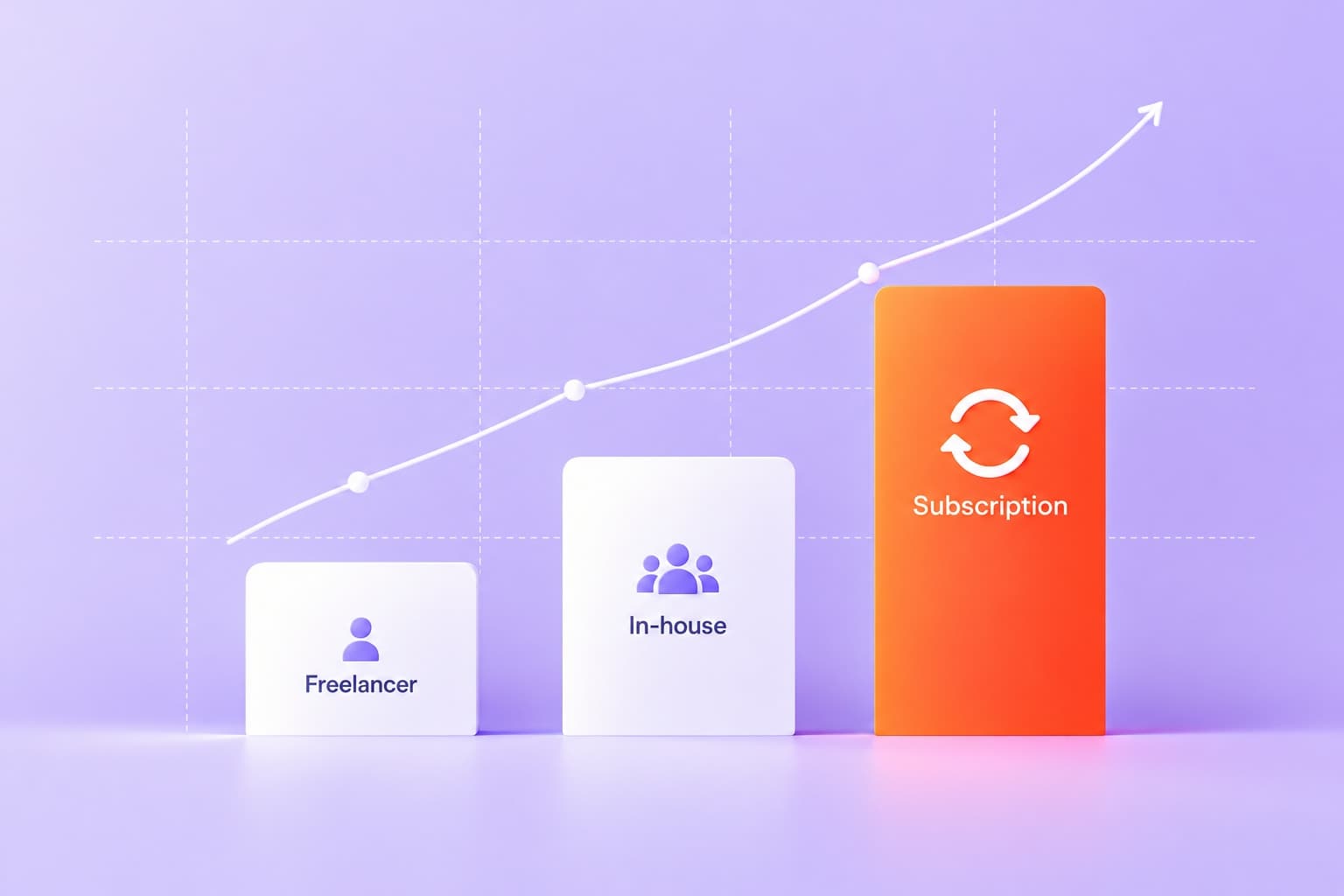
- Fixed price or time and materials. Fixed price (Upsilon, Purrweb after discovery, 99 Francs per phase) puts the overrun on the agency, with a buffer built into the price. Time and materials (Goji Labs) is often cheaper when scope is clear and changes are few, but the total is an estimate. Either way, ask what happens when scope changes mid-build; our answer on building an MVP at a fixed price compares the two.
- Who owns the code. Every agency here that addresses it says the client owns what it builds. Put it in the contract, and keep the code repository, cloud, domain and app-store accounts in your company's name from day one.
- Design and engineering under one roof. An MVP fails as often on an unclear flow as on bad code. Ask who designs the screens and whether that person works with the developers every day or hands over a file.
- What happens after launch. Bug fixes, analytics and the next iteration: ask whether support is a retainer, hourly or a new phase, and what it costs. See what happens after the MVP launches.
- How you pay. Deposits are common, but some agencies take the risk instead: Upsilon takes no advance payment and refunds the first sprint, Designli refunds the first two weeks, and 99 Francs takes no deposit and is paid at the end of each phase. How we work shows our model in full.
- Who does the work. Ask for the names and seniority of the people on your project, not the agency's headcount.
Red flags
- A quote for the full product before anyone has asked who the first user is.
- No discovery or scope phase, or one you cannot buy on its own and walk away with.
- Code, cloud or app-store accounts held by the agency "for convenience".
- A stack chosen because the agency always uses it, with no reason tied to your product.
- Pressure to pay a large deposit before you have seen any work.
- No answer to "how would we move off this platform?" for a no-code build.
Still deciding whether you need an agency at all? Read agency or CTO for a non-technical founder's MVP and how long it takes to build an MVP, and see how we build MVPs with no upfront payment.