 New Zealand
 Norway
 Malta
 UAE





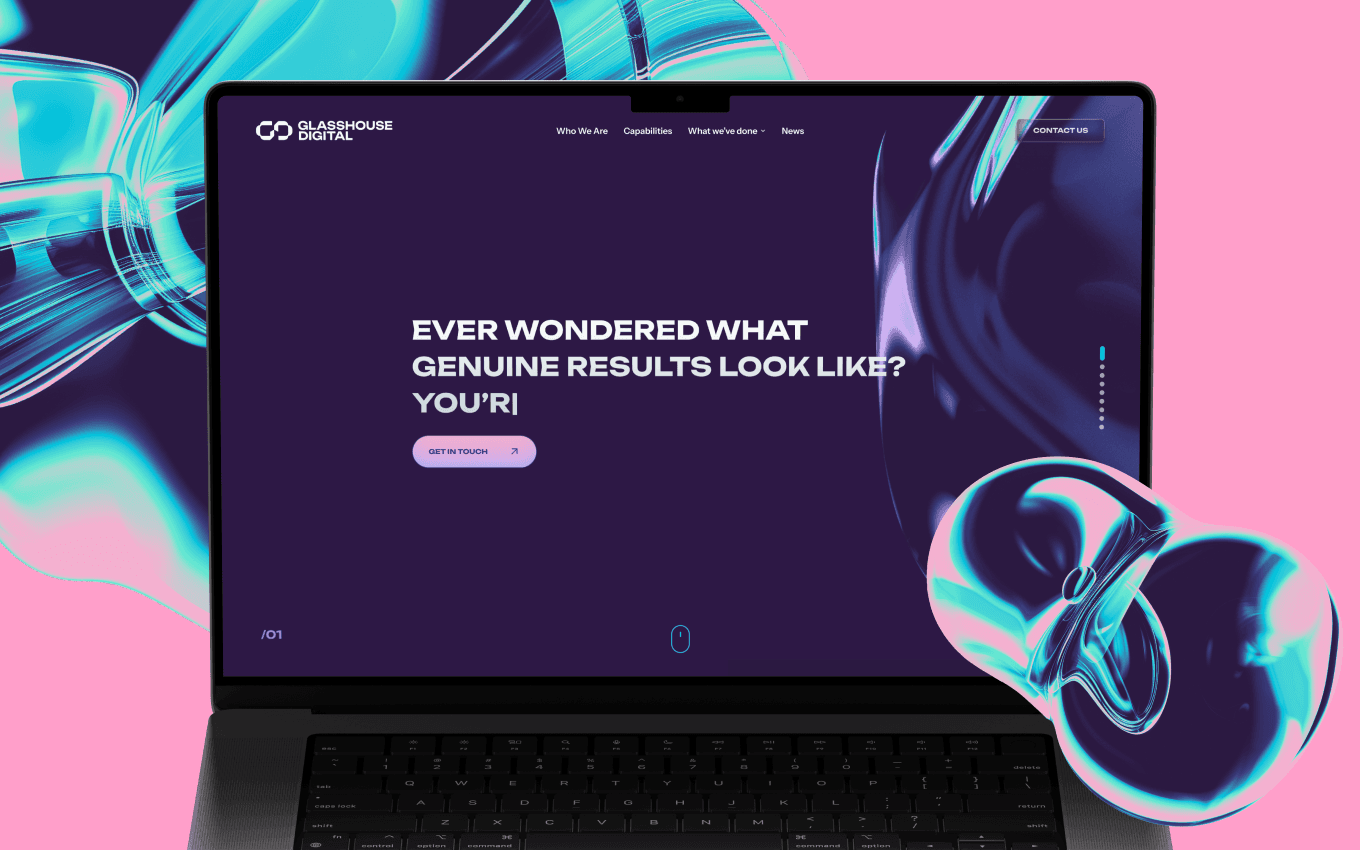


This guide is for property developers and their marketing teams, wherever the development is: what the site has to do, how to structure it when you sell more than one project, which platform keeps it editable, how long a launch takes and what it costs. The examples are our own work: three Auckland developments built with Glasshouse Digital, and a real estate agency website for the Dubai market.
What a development website has to do
An agency website sells many listings all year. A developer's site sells one place, often before it exists, to a launch date, and its job ends when the last home sells. That changes the brief: the site has to make an unbuilt place feel real, keep availability honest week by week, and get every enquiry to a person quickly.
| Element | What it does | What to get right |
|---|---|---|
| Availability and price list | Shows every home or unit with its status, and its price where you publish prices | Status fields (available, reserved, sold) the sales team changes in minutes, without a developer |
| Floor plans | Lets buyers compare layouts and sizes | A plan per home as an image and a PDF, linked from the availability list |
| Gallery and video | Sells the architecture and finishes before they exist | Large renders that stay fast on phones, and video that loads only when someone plays it |
| Location | Shows the neighbourhood, transport, schools and views | Real distances and real places, not a stock photo of the city |
| Enquiry routing | Gets each lead to the right agent | Forms tested end to end, with spam protection, email authentication and a copy in the CRM |
| Multi-project CMS | Adds the next development as content | One collection for developments and one for homes, so a launch is a new entry, not a new site |
| Second language | Reaches buyers abroad | Translated pages on their own URLs, not a translation widget |
| Analytics | Measures launch spend against enquiries | An enquiry counted as a conversion from the first day |
One site per development, or one site for the company
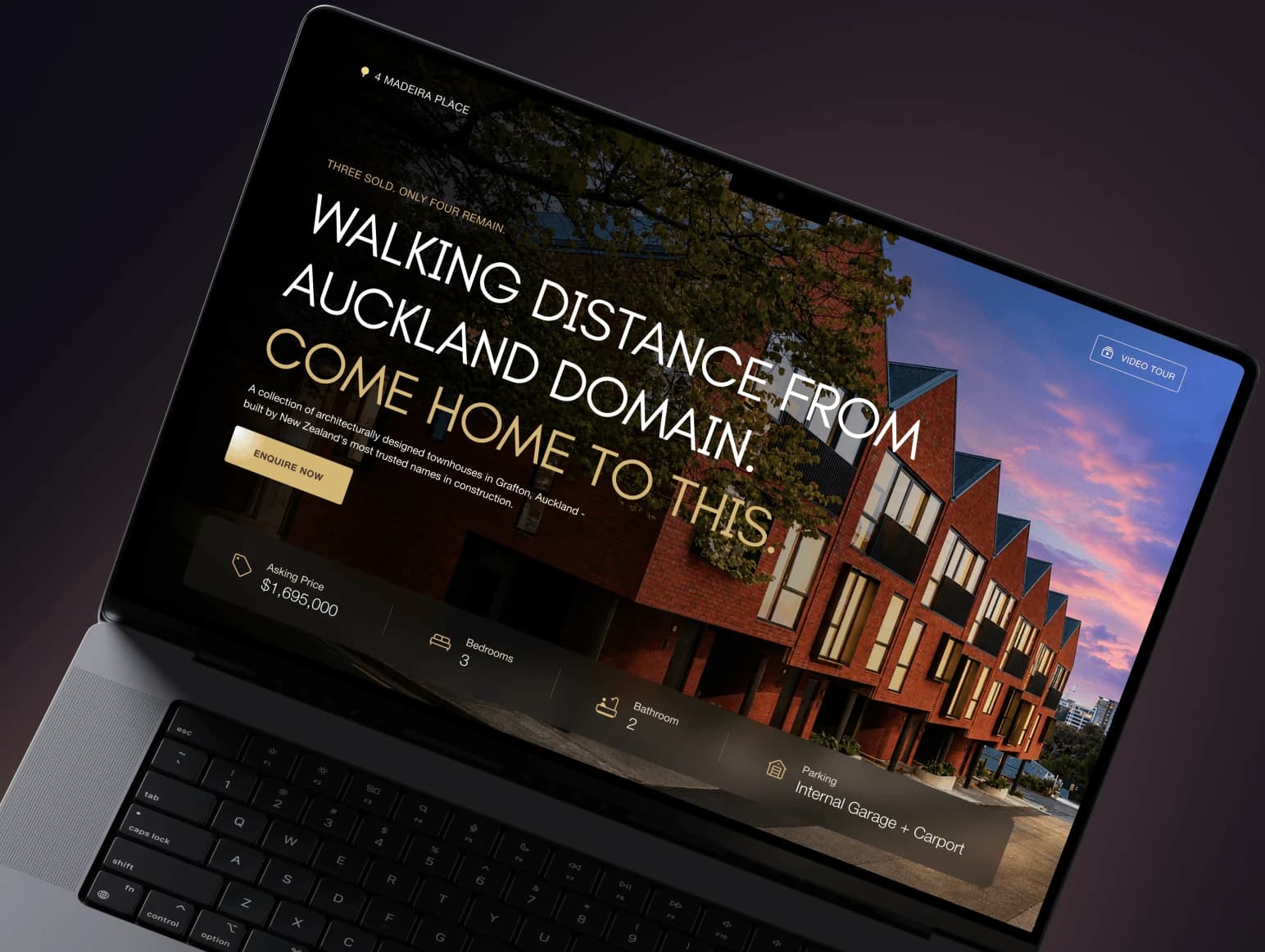
Both work, and the choice follows how you sell. A site per development gets its own domain, design and enquiry flow, built around one launch: 4 Madeira Place and The Pacifica Penthouse were separate sites with separate deadlines. A company site carries the track record, the team and every development, with a page per project from the CMS, which suits a developer whose name sells the homes. For a short promotion you may need neither: the Vines Estate campaign was a single landing page shipped inside the developer's existing WordPress and Divi site, and every home in the campaign sold.
Why Webflow suits editable listings
Availability changes every week until the last home sells, so the deciding question is who updates it. In Webflow, each home is a CMS item with fields for status, price, bedrooms, size and floor plan, and the sales team edits them in the browser without touching the design. Hosting, security and updates are Webflow's job, so there are no plugins to keep current. On 30 October 2026 a Webflow site plan with the CMS cost US$25 a month billed yearly, and the Localize add-on for a second language started at US$9 a month (Webflow pricing).
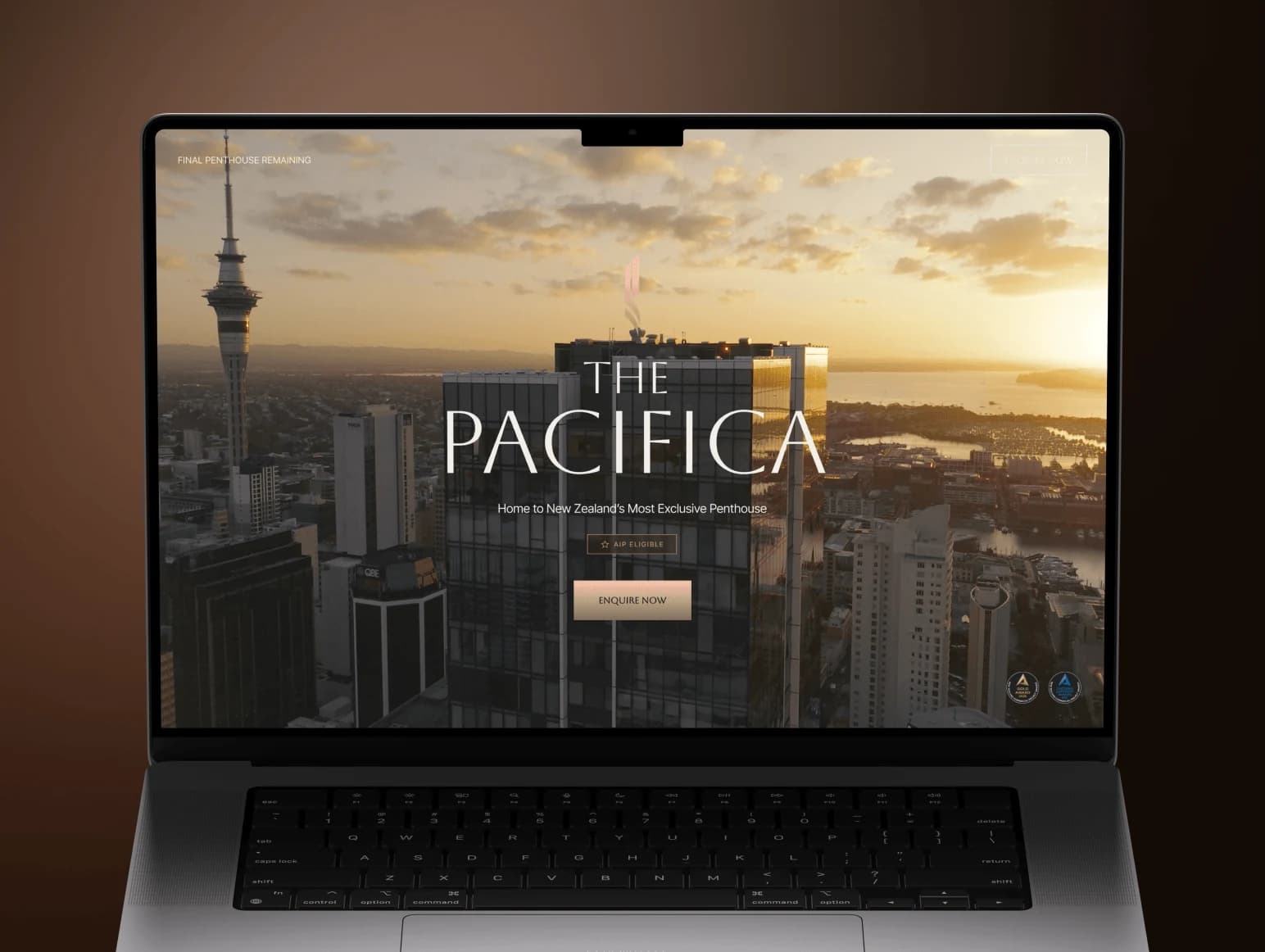
On 4 Madeira Place, a townhouse development in Grafton, Auckland, the marketing team keeps listings, availability and pricing current in the Webflow CMS; the site went live in two weeks. The Pacifica Penthouse, a single-level residence on the 54th floor of an Auckland CBD tower, went live in four, with the listing, gallery and enquiry details editable the same way. For buyers abroad, we added a Chinese version with its own /zh/ URLs to a live Webflow site on Webflow Localization for Z Performance, an Auckland clinic; a development reaches overseas buyers the same way. WordPress stays the sensible choice when a developer already runs on it: our comparison of WordPress and Webflow for property developers covers the trade-offs, and Webflow development describes how we build.
Enquiry routing: where development sites lose leads
The most expensive failure on a development site is silent. On Trivelle Gardens, a townhouse development in Hobsonville, Auckland, an anti-spam component was rejecting every enquiry: visitors saw a validation error, the agents saw nothing, and the emails that did go out were landing in quarantine. Whatever the platform, submit the form as a buyer would, from a phone, and follow the message to the agent's inbox and into the CRM.
- One enquiry address per development, so a lead never lands with the wrong agent.
- SPF, DKIM and DMARC on the sending domain, so notifications do not end up in spam.
- A copy of each enquiry in the CRM or a shared sheet, so nothing depends on one inbox.
- A short reply to the buyer that confirms the enquiry and says when an agent will be in touch.
- Register-interest forms that ask only what the agent needs for the first call.
Launch timeline for a development website
| When | What happens | What the developer provides |
|---|---|---|
| Before week 1 | A short call about the development, the launch date and the channels; scope and price fixed | Launch date, number of homes, renders, plans, brand |
| Week 1 | Structure and design direction: the place, the homes and the path to an enquiry; you approve the direction | Feedback on the direction |
| Weeks 2–3 | Webflow build: homes in the CMS, gallery, floor plans, location and the enquiry flow | Prices, availability and copy |
| Weeks 3–4 | QA on real phones, forms tested end to end, analytics, launch | Agents' email addresses and CRM access |
| After launch | Support rounds as homes sell and the campaign changes | Changes as they come |
4 Madeira Place went live in two weeks and The Pacifica Penthouse in four. Most development sites take three to six weeks, depending on the number of homes, galleries and integrations, and a campaign landing page takes about a week. For comparison, Kolonell's 2026 guide puts a Miami developer website at 9–14 weeks.
What a real estate developer website costs in 2026
| Option | Published price | Source |
|---|---|---|
| Simple informational site, about 10 pages | US$1,000–2,000 | ColorWhistle |
| Site with property search and detail pages, 40+ pages | US$2,000–6,000 | ColorWhistle |
| Developer website, Lyon | €7,000–18,000, 8–11 weeks | Kolonell |
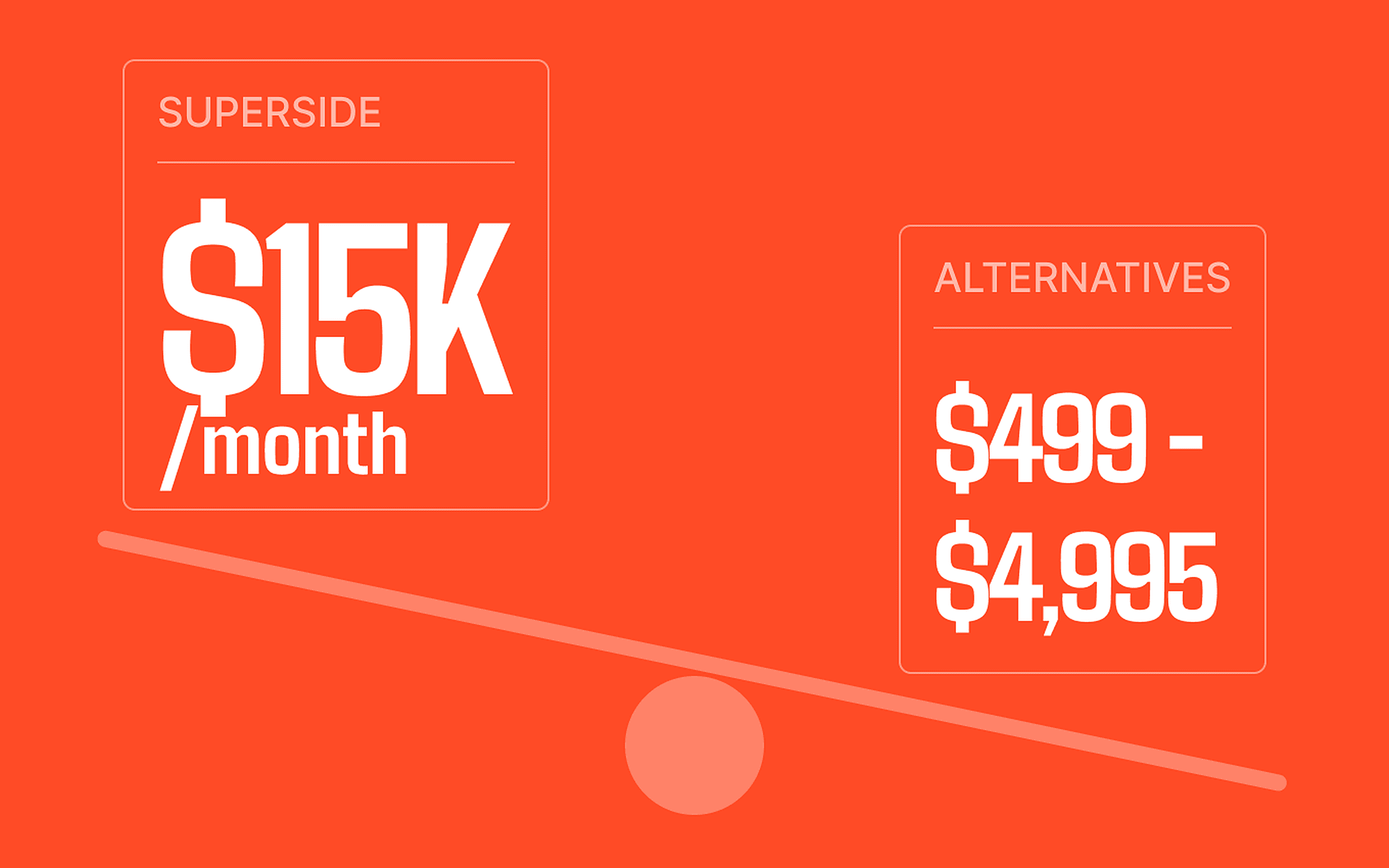
| Developer website, Miami: Essential (8–10 pages, 3–5 projects, PDF floor plans) | US$12,000–17,000, 9 weeks | Kolonell |
| Miami: Professional (unlimited projects, filters, CRM, blog) | US$17,000–25,000, 10–12 weeks | Kolonell |
| Miami: Premium (3D tour, unit configurator, buyer portal) | US$25,000–35,000, 14 weeks | Kolonell |
| 99 Francs: campaign or launch landing page | From US$1,500, paid once when it is done | Our price |
| 99 Francs: developer website, 5–10 pages | From US$3,000, paid once when it is done | Our price |
| 99 Francs: full project site with listings, availability and a second language | US$4,500–8,500, in fixed-price phases | Our price |
Sources, checked 30 October 2026: Kolonell's 2026 guide to developer website costs in Miami (published 6 September 2026, with Lyon for comparison), which also puts monthly maintenance at US$400–1,000, and ColorWhistle's real estate website pricing (dated 27 July 2026). Add the platform on top: a Webflow site plan with the CMS is US$25 a month billed yearly. For a New Zealand budget broken down phase by phase, see what a property development website costs in New Zealand.
How we charge: a landing page or a developer website is paid once, when it is done. A full project site with listings and more than one language runs in fixed-price phases, each paid after you have seen it working. There is never a deposit, and either side can stop between phases, keeping everything produced so far. The full offer is on our page for property developer websites; developers in New Zealand have a page of their own with NZD prices and Auckland casework.
Selling through an agency: a Dubai example
An agency that sells many developments needs a different shape: a catalogue with search and filters, listing pages built for comparison, and a brand that reads as premium. For a Dubai real estate agency, two of our designers redesigned the homepage, the visual identity, the property catalogue and the detailed listing pages in two weeks, starting from several homepage concepts to find a direction that fit the Dubai market. Agency and listing work is covered on our real estate web design page, and developers selling off-plan have their own page on websites for property developers in the UAE, with prices in AED.
A pre-launch checklist
- Every home on the availability list has a status, and someone in the sales team has changed one themselves.
- Each enquiry form has been submitted from a phone and reached the right agent and the CRM.
- Renders and gallery images are compressed, and the home page loads quickly over mobile data.
- Floor plan PDFs open on a phone and match the homes they belong to.
- Each development has its own page title, description and sharing image.
- Analytics counts an enquiry as a conversion before any ad money is spent.