









 By Alexander Vinokurov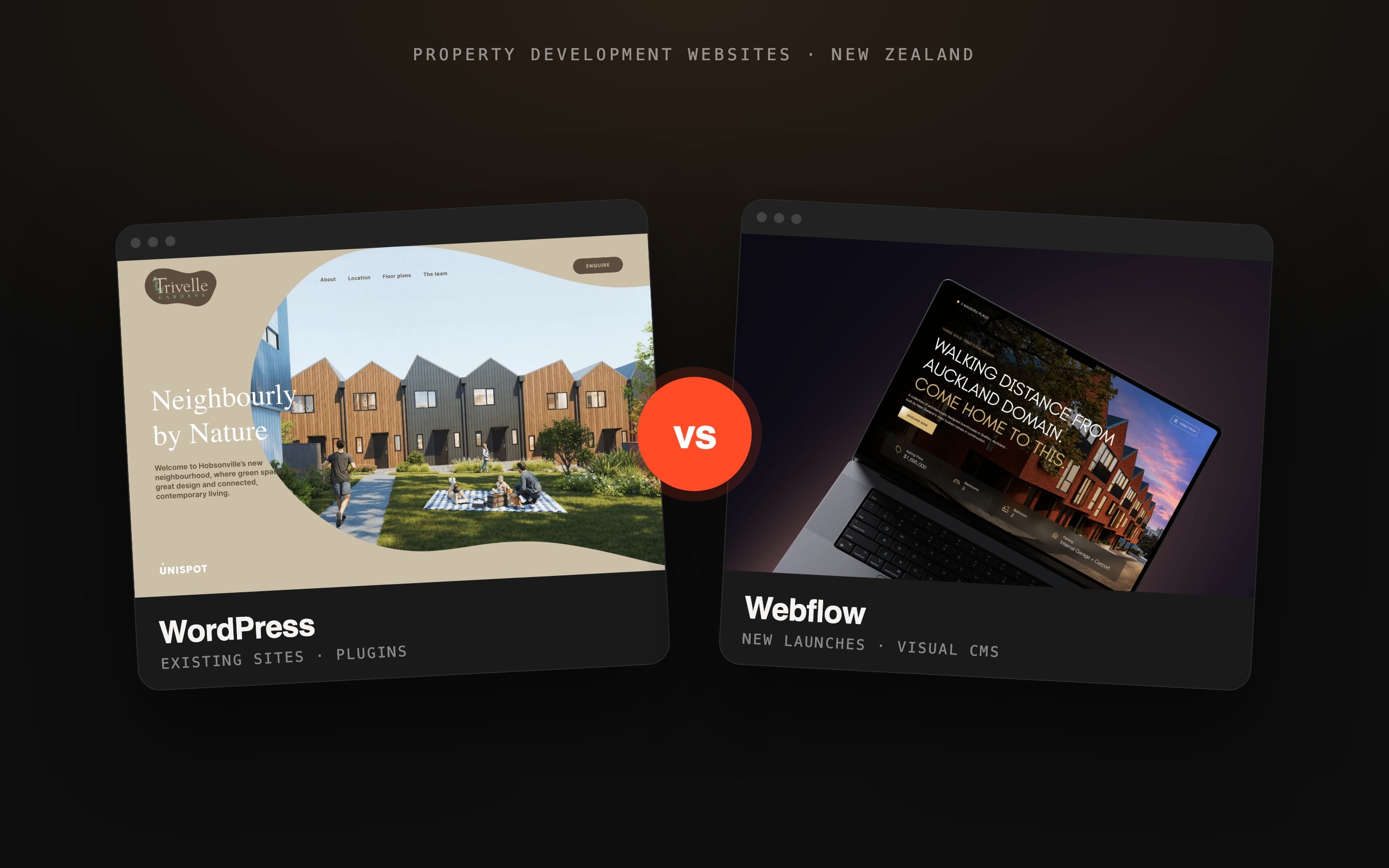
Property developers in New Zealand often ask for WordPress by name — it is what their last site ran on, and what the agency before us used. It is a fair starting point. But a development website has an unusual job: it goes live on a fixed date, carries paid traffic for a few months, has to capture every enquiry, and is edited by a sales team rather than a developer. That job is where the differences between WordPress and Webflow start to matter. We build and support property sites on both, so this is not a pitch for one platform.
WordPress vs Webflow for a property launch, side by side
| What matters on a launch | WordPress | Webflow |
|---|---|---|
| Hosting and running cost | Software is free; managed hosting commonly NZ$39–99 a month, plus maintenance | US$25 a month on the CMS site plan billed yearly, hosting included |
| Updates and maintenance | Core, theme and every plugin need updating — a standing maintenance line | Platform updates are handled by Webflow; no plugins to patch |
| Security surface | Grows with each plugin and each admin account | Managed platform; no server or plugin code to secure |
| Enquiry forms | Form plugin + mail setup; can fail silently if email delivery is misconfigured | Built-in forms and notifications; still worth testing end to end |
| Editing homes, prices and agents | Custom fields or a page builder — depends on how the site was built | Visual CMS collections the sales team edits directly |
| Premium design and motion | Depends on theme or page builder; heavy builders slow pages down | Custom layouts and interactions without extra plugins |
| Best when | You already run WordPress, need a specific plugin, or add a campaign to an existing site | A new launch site the marketing team will run for months |
Running costs checked 26 September 2026: managed WordPress hosting at NZ$39–99 a month and maintenance plans at NZ$50–200 a month are the ranges published by Fuel Design and Horton Taylor, before GST. Webflow bills its site plans in US dollars. The full breakdown is in our guide to website development costs in New Zealand.
Where WordPress quietly costs a developer leads
The most expensive WordPress problem on a property site is not a hack or a slow page. It is an enquiry form that looks fine and delivers nothing. On a support round for Trivelle Gardens, a townhouse development in Hobsonville, we found the enquiry form silently rejecting every submission. Visitors saw a form, filled it in and moved on; the emails never reached the agents, and nobody knew until we traced why they were being quarantined.
That failure is typical of how WordPress sites age. A theme, a page builder, a form plugin, a spam plugin and an email setup are maintained by different people, and a change in one breaks another without an error anyone sees. None of it is unfixable — we fixed it, and moved agents, viewing dates and hero media into fields the client now edits himself — but on a launch carrying paid traffic, every silent week is lost buyers.
When WordPress is the right call
Rebuilding a working site just to change platform is rarely worth it mid-campaign. For Vines Estate, the developer already ran WordPress with the Divi builder and needed a deadline campaign — buy a home, win the purchase price back — live fast. We built the full custom landing page inside the existing site as one module, sealed off from the theme with Shadow DOM so nothing else on the site could break it. All 10 homes in the campaign sold, and the client's agency credits the landing with a large part of that.
- Your site already runs WordPress and the team knows it.
- You need a campaign or a new section, not a new website.
- A plugin you depend on — a CRM, a booking or a listings feed — only exists for WordPress.
- Someone owns maintenance: updates, backups and a monthly check that the forms still deliver.
When Webflow is the right call
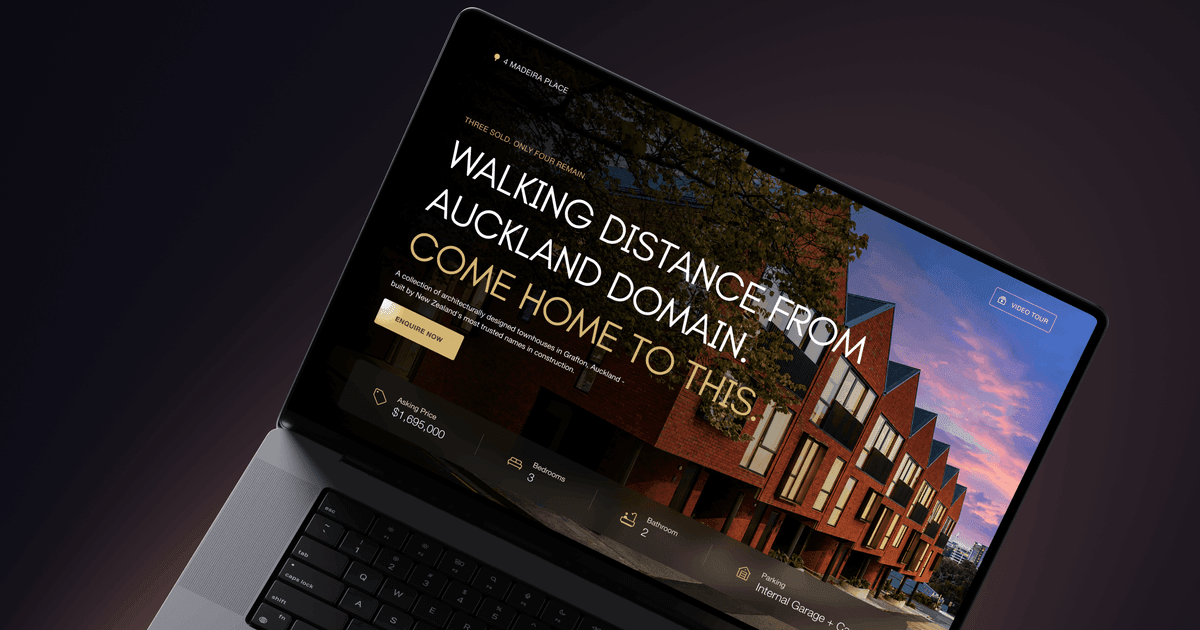
For a new launch, Webflow removes most of the maintenance list. 4 Madeira Place, a townhouse development in Grafton, went live in two weeks with its content in the Webflow CMS, fully editable by the marketing team. The Pacifica Penthouse, a 54th-floor residence in Auckland's CBD, went live in four. Neither needs plugin updates, and both were built with the editorial layouts and motion a premium development expects.
- You are launching a new development and the site will carry paid traffic.
- The sales team needs to update homes, prices, availability and agents without a developer.
- You want premium design and motion without stacking page-builder plugins.
- Nobody on your side wants to own server, plugin or security updates.
Speed and SEO: what actually differs
Neither platform ranks a site by itself. A lean WordPress theme can be fast, and a Webflow site overloaded with video can be slow. The practical difference is where the weight comes from: on WordPress it accumulates through page builders and plugins, each adding scripts to every page; on Webflow it comes mostly from the content you choose to add. Buyers first see a development on their phones, so whichever platform you choose, test the launch pages on a real mid-range phone over mobile data before the ads go live.
Our recommendation
- New development, new site, marketing team in charge: build it in Webflow.
- Existing WordPress site that works: keep it, add the campaign as a module, and put the forms under a monthly check.
- Existing WordPress site that keeps breaking: fix the enquiry flow first, then decide whether a WordPress to Webflow migration is worth it.
- Either way: test every enquiry form end to end before launch, and again after every update.
We build property development websites for Auckland and New Zealand on either platform: NZ$8–15K for a full launch site and from NZ$2,000 for a single campaign landing, with no GST added and no upfront payment. If your site is already on WordPress, website support covers the fixes without a rebuild.
Frequently asked questions.
Launching a development in New Zealand?
Tell us about the development and the launch date. We will recommend the platform, fix the scope per phase and send a fixed NZD quote — no deposit.